


Page 196 - Elementary_Linear_Algebra_with_Applications_Anton__9_edition
P. 196
(b) Find the point on the line segment connecting P and Q that is of the way from P to Q.

     Suppose an -coordinate system is translated to obtain an  -coordinate system whose origin has -coordinates ( ,
12. ).

(a) Find the -coordinates of the point P whose -coordinates are (7, 5).

(b) Find the -coordinates of the point Q whose -coordinates are ( , 6).

(c) Draw the and -coordinate axes and locate the points P and Q.

(d) If              is a vector in the -coordinate system, what are the components of v in the -coordinate system?

(e) If              is a vector in the -coordinate system, what are the components of v in the -coordinate system?

     Let P be the point (1, 3, 7). If the point (4, 0, ) is the midpoint of the line segment connecting P and Q, what is Q?
13.

Suppose that an -coordinate system is translated to obtain an  -coordinate system. Let v be a vector whose

14. components are           in the -system. Show that v has the same components in the            -system.

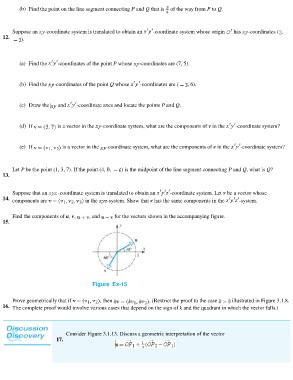
     Find the components of u, v, , and for the vectors shown in the accompanying figure.
15.

                             Figure Ex-15

Prove geometrically that if  , then                            . (Restrict the proof to the case   illustrated in Figure 3.1.8.

16. The complete proof would involve various cases that depend on the sign of k and the quadrant in which the vector falls.)

                         Consider Figure 3.1.13. Discuss a geometric interpretation of the vector
                    17.

