


Page 200 - Elementary_Linear_Algebra_with_Applications_Anton__9_edition
P. 200
, and , then

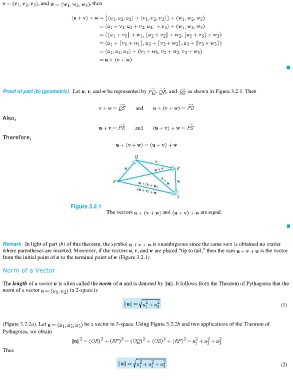
Proof of part (b) (geometric) Let u, v, and w be represented by , , and as shown in Figure 3.2.1. Then

Also,
Therefore,

                       Figure 3.2.1
                                          The vectors and are equal.

Remark In light of part (b) of this theorem, the symbol                 is unambiguous since the same sum is obtained no matter

where parentheses are inserted. Moreover, if the vectors u, v, and w are placed “tip to tail,” then the sum  is the vector

from the initial point of u to the terminal point of w (Figure 3.2.1).

Norm of a Vector

The length of a vector u is often called the norm of u and is denoted by . It follows from the Theorem of Pythagoras that the

norm of a vector       in 2-space is

                                                                                                             (1)

(Figure 3.2.2a). Let   be a vector in 3-space. Using Figure 3.2.2b and two applications of the Theorem of
Pythagoras, we obtain

Thus

                                                                                                             (2)

