


Page 202 - Elementary_Linear_Algebra_with_Applications_Anton__9_edition
P. 202
In theory, knowing three ship-to-satellite distances would suffice to determine the three unknown coordinates of the ship.
However, the problem is that the ships (or other GPS users) do not generally have clocks that can compute t with sufficient
accuracy for global positioning. Thus, the variable t must be regarded as a fourth unknown, and hence the need for the
distance to a fourth satellite. Suppose that in addition to transmitting the time , each satellite also transmits its coordinates (

  , , ) at that time, thereby allowing d to be computed as

If we now equate the squares of d from both equations and round off to three decimal places, then we obtain the
second-degree equation

Since there are four different satellites, and we can get an equation like this for each one, we can produce four equations in
the unknowns x, y, z, and . Although these are second-degree equations, it is possible to use these equations and some
algebra to produce a system of linear equations that can be solved for the unknowns.

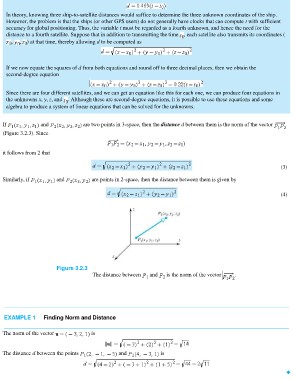
If and                             are two points in 3-space, then the distance d between them is the norm of the vector
(Figure 3.2.3). Since

it follows from 2 that

Similarly, if           and        are points in 2-space, then the distance between them is given by                            (3)
                                                                                                                                (4)

                        Figure 3.2.3                                                           .
                                           The distance between and is the norm of the vector

EXAMPLE 1 Finding Norm and Distance

The norm of the vector             is

The distance d between the points      and  is

