


Page 336 - Elementary_Linear_Algebra_with_Applications_Anton__9_edition
P. 336
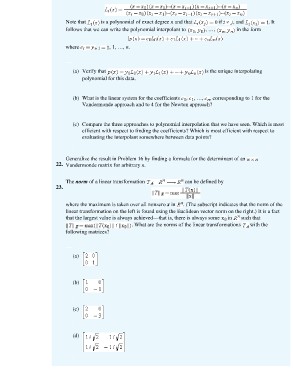
Note that  is a polynomial of exact degree n and that           if  , and                . It
                                                         , …,
follows that we can write the polynomial interpolant to             in the form

where      , , 1, …, n.

(a) Verify that                                          is the unique interpolating
     polynomial for this data.

(b) What is the linear system for the coefficients , , …, , corresponding to 1 for the
     Vandermonde approach and to 4 for the Newton approach?

(c) Compare the three approaches to polynomial interpolation that we have seen. Which is most
     efficient with respect to finding the coefficients? Which is most efficient with respect to
     evaluating the interpolant somewhere between data points?

     Generalize the result in Problem 16 by finding a formula for the determinant of an
22. Vandermonde matrix for arbitrary n.

     The norm of a linear transformation  can be defined by
23.

where the maximum is taken over all nonzero x in . (The subscript indicates that the norm of the
linear transformation on the left is found using the Euclidean vector norm on the right.) It is a fact
that the largest value is always achieved—that is, there is always some in such that

                                    . What are the norms of the linear transformations with the
following matrices?

(a)

(b)

(c)

(d)

