


Page 335 - Elementary_Linear_Algebra_with_Applications_Anton__9_edition
P. 335
with and distinct, and that a unique parabola (which may be degenerate, such as a line) can be fit through any

three points , ,                               with , , and distinct.

17.
         (a) What form does 5 take for lines?

(b) What form does 5 take for quadratics?

(c) What form does 5 take for quartics?

18. (For Readers Who Have Studied Calculus)

         (a) Does indefinite integration of functions in correspond to some linear transformation from
                     to ?

(b) Does definite integration (from                                    to ) of functions in correspond to some linear

                  transformation from          to R?

19. (For Readers Who Have Studied Calculus)

         (a) What matrix corresponds to second differentiation of functions from (giving functions in
                 )?

         (b) What matrix corresponds to second differentiation of functions from (giving functions in
                 )?

         (c) Is the matrix for second differentiation the square of the matrix for (first) differentiation?

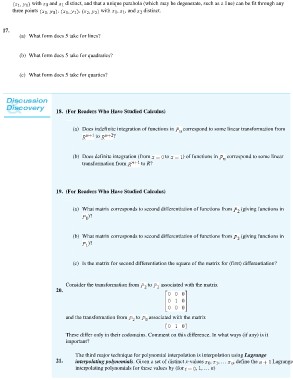
     Consider the transformation from to associated with the matrix
20.

and the transformation from to associated with the matrix

These differ only in their codomains. Comment on this difference. In what ways (if any) is it
important?

The third major technique for polynomial interpolation is interpolation using Lagrange

21. interpolating polynomials. Given a set of distinct x-values , , … , define the             Lagrange

interpolating polynomials for these values by (for , 1, … n)

