


Page 481 - Elementary_Linear_Algebra_with_Applications_Anton__9_edition
P. 481
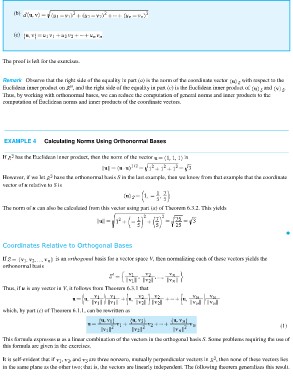
(b)

     (c)

The proof is left for the exercises.

Remark Observe that the right side of the equality in part (a) is the norm of the coordinate vector with respect to the
Euclidean inner product on , and the right side of the equality in part (c) is the Euclidean inner product of and .
Thus, by working with orthonormal bases, we can reduce the computation of general norms and inner products to the
computation of Euclidean norms and inner products of the coordinate vectors.

EXAMPLE 4 Calculating Norms Using Orthonormal Bases                is
If has the Euclidean inner product, then the norm of the vector

However, if we let have the orthonormal basis S in the last example, then we know from that example that the coordinate
vector of u relative to S is

The norm of u can also be calculated from this vector using part (a) of Theorem 6.3.2. This yields

Coordinates Relative to Orthogonal Bases

If                 is an orthogonal basis for a vector space V, then normalizing each of these vectors yields the
orthonormal basis

Thus, if u is any vector in V, it follows from Theorem 6.3.1 that

which, by part (c) of Theorem 6.1.1, can be rewritten as

                                                                                                                                                   (1)

This formula expresses u as a linear combination of the vectors in the orthogonal basis S. Some problems requiring the use of
this formula are given in the exercises.

It is self-evident that if , , and are three nonzero, mutually perpendicular vectors in , then none of these vectors lies
in the same plane as the other two; that is, the vectors are linearly independent. The following theorem generalizes this result.

