


Page 482 - Elementary_Linear_Algebra_with_Applications_Anton__9_edition
P. 482
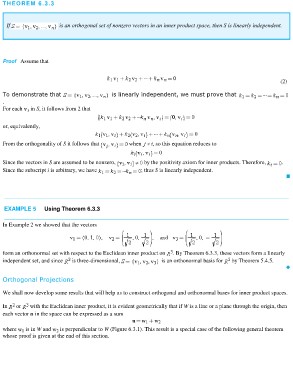
THEOREM 6.3.3
  If is an orthogonal set of nonzero vectors in an inner product space, then S is linearly independent.

Proof Assume that

                                                                                                            (2)

To demonstrate that                          is linearly independent, we must prove that

.
For each in S, it follows from 2 that

or, equivalently,

From the orthogonality of S it follows that        when , so this equation reduces to

Since the vectors in S are assumed to be nonzero,   by the positivity axiom for inner products. Therefore,  .
Since the subscript i is arbitrary, we have        ; thus S is linearly independent.

EXAMPLE 5 Using Theorem 6.3.3
In Example 2 we showed that the vectors

form an orthonormal set with respect to the Euclidean inner product on . By Theorem 6.3.3, these vectors form a linearly

independent set, and since is three-dimensional,   is an orthonormal basis for by Theorem 5.4.5.

Orthogonal Projections

We shall now develop some results that will help us to construct orthogonal and orthonormal bases for inner product spaces.

In or with the Euclidean inner product, it is evident geometrically that if W is a line or a plane through the origin, then
each vector u in the space can be expressed as a sum

where is in W and is perpendicular to W (Figure 6.3.1). This result is a special case of the following general theorem
whose proof is given at the end of this section.

