


Page 485 - Elementary_Linear_Algebra_with_Applications_Anton__9_edition
P. 485
Proof Let V be any nonzero finite-dimensional inner product space, and suppose that        is any basis for V. It

suffices to show that V has an orthogonal basis, since the vectors in the orthogonal basis can be normalized to produce an

orthonormal basis for V. The following sequence of steps will produce an orthogonal basis  for V.

Jörgen Pederson Gram (1850–1916) was a Danish actuary. Gram's early education was at village schools supplemented
by private tutoring. After graduating from high school, he obtained a master's degree in mathematics with specialization in
the newly developing modern algebra. Gram then took a position as an actuary for the Hafnia Life Insurance Company,
where he developed mathematical foundations of accident insurance for the company Skjold. He served on the Board of
Directors of Hafnia and directed Skjold until 1910, at which time he became director of the Danish Insurance Board.
During his employ as an actuary, he earned a Ph.D. based on his dissertation “On Series Development Utilizing the Least
Squares Method.” It was in this thesis that his contributions to the Gram– Schmidt process were first formulated. Gram
eventually became interested in abstract number theory and won a gold medal from the Royal Danish Society of Sciences
and Letters for his contributions to that field. However, he also had a lifelong interest in the interplay between theoretical
and applied mathematics that led to four treatises on Danish forest management. Gram was killed one evening in a bicycle
collision on the way to a meeting of the Royal Danish Society.

Step 1. Let       .

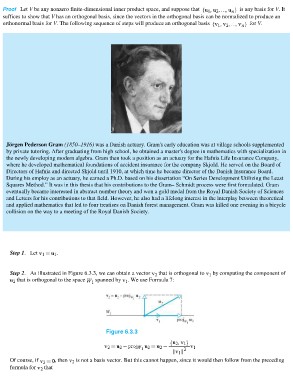
Step 2. As illustrated in Figure 6.3.3, we can obtain a vector that is orthogonal to by computing the component of
   that is orthogonal to the space spanned by . We use Formula 7:

                     Figure 6.3.3

Of course, if     , then is not a basis vector. But this cannot happen, since it would then follow from the preceding

formula for that

