


Page 519 - Elementary_Linear_Algebra_with_Applications_Anton__9_edition
P. 519
(a) Identify the bases for used for interpolation in the standard form (found by using the Vandermonde system), the

Newton form, and the Lagrange form, assuming  , , and .

(b) What is the transition matrix from the Newton form basis to the standard basis?

     To write the coordinate vector for a vector, it is necessary to specify an order for the vectors in the basis. If P is the transition
14. matrix from a basis to a basis B, what is the effect on P if we reverse the order of vectors in B from , …, to , …,

        ? What is the effect on P if we reverse the order of vectors in both and B?

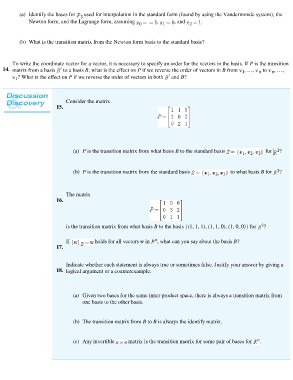
     Consider the matrix
15.

         (a) P is the transition matrix from what basis B to the standard basis      for ?

         (b) P is the transition matrix from the standard basis                      to what basis B for ?

     The matrix
16.

is the transition matrix from what basis B to the basis {(1, 1, 1), (1, 1, 0), (1, 0, 0)} for ?

     If          holds for all vectors w in , what can you say about the basis B?
17.

     Indicate whether each statement is always true or sometimes false. Justify your answer by giving a
18. logical argument or a counterexample.

         (a) Given two bases for the same inner product space, there is always a transition matrix from
              one basis to the other basis.

         (b) The transition matrix from B to B is always the identify matrix.

         (c) Any invertible matrix is the transition matrix for some pair of bases for .

