


Page 522 - Elementary_Linear_Algebra_with_Applications_Anton__9_edition
P. 522
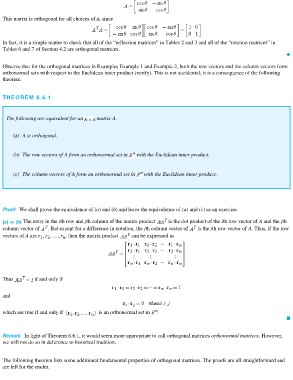
This matrix is orthogonal for all choices of , since

In fact, it is a simple matter to check that all of the “reflection matrices” in Tables 2 and 3 and all of the “rotation matrices” in
Tables 6 and 7 of Section 4.2 are orthogonal matrices.
Observe that for the orthogonal matrices in Examples Example 1 and Example 2, both the row vectors and the column vectors form
orthonormal sets with respect to the Euclidean inner product (verify). This is not accidental; it is a consequence of the following
theorem.

THEOREM 6.6.1

  The following are equivalent for an matrix A.
     (a) A is orthogonal.

     (b) The row vectors of A form an orthonormal set in with the Euclidean inner product.

     (c) The column vectors of A form an orthonormal set in with the Euclidean inner product.

Proof We shall prove the equivalence of (a) and (b) and leave the equivalence of (a) and (c) as an exercise.
           The entry in the ith row and jth column of the matrix product is the dot product of the ith row vector of A and the jth

column vector of . But except for a difference in notation, the jth column vector of is the jth row vector of A. Thus, if the row
vectors of A are , , …, , then the matrix product can be expressed as

Thus  if and only if

and

which are true if and only if  is an orthonormal set in .

Remark In light of Theorem 6.6.1, it would seem more appropriate to call orthogonal matrices orthonormal matrices. However,
we will not do so in deference to historical tradition.

The following theorem lists some additional fundamental properties of orthogonal matrices. The proofs are all straightforward and
are left for the reader.

