


Page 524 - Elementary_Linear_Algebra_with_Applications_Anton__9_edition
P. 524
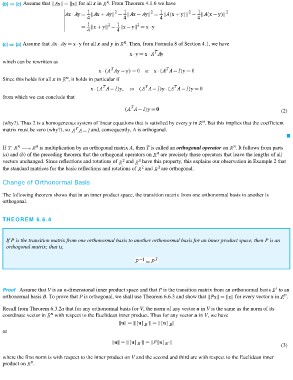
Assume that                      for all x in . From Theorem 4.1.6 we have

Assume that                      for all x and y in . Then, from Formula 8 of Section 4.1, we have

which can be rewritten as

Since this holds for all x in , it holds in particular if

from which we can conclude that

                                                                                                                                (2)

(why?). Thus 2 is a homogeneous system of linear equations that is satisfied by every y in . But this implies that the coefficient

matrix must be zero (why?), so   and, consequently, A is orthogonal.

If is multiplication by an orthogonal matrix A, then T is called an orthogonal operator on . It follows from parts
(a) and (b) of the preceding theorem that the orthogonal operators on are precisely those operators that leave the lengths of all
vectors unchanged. Since reflections and rotations of and have this property, this explains our observation in Example 2 that
the standard matrices for the basic reflections and rotations of and are orthogonal.

Change of Orthonormal Basis

The following theorem shows that in an inner product space, the transition matrix from one orthonormal basis to another is
orthogonal.

THEOREM 6.6.4

If P is the transition matrix from one orthonormal basis to another orthonormal basis for an inner product space, then P is an
orthogonal matrix; that is,

Proof Assume that V is an n-dimensional inner product space and that P is the transition matrix from an orthonormal basis to an

orthonormal basis B. To prove that P is orthogonal, we shall use Theorem 6.6.3 and show that        for every vector x in .

Recall from Theorem 6.3.2a that for any orthonormal basis for V, the norm of any vector u in V is the same as the norm of its
coordinate vector in with respect to the Euclidean inner product. Thus for any vector u in V, we have

or

                                                                                                                                                            (3)

where the first norm is with respect to the inner product on V and the second and third are with respect to the Euclidean inner
product on .

