


Page 525 - Elementary_Linear_Algebra_with_Applications_Anton__9_edition
P. 525
Now let x be any vector in , and let u be the vector in V whose coordinate vector with respect to the basis is x; that is,
            . Thus, from 3,

which proves that P is orthogonal.

EXAMPLE 4 Application to Rotation of Axes in 2-Space

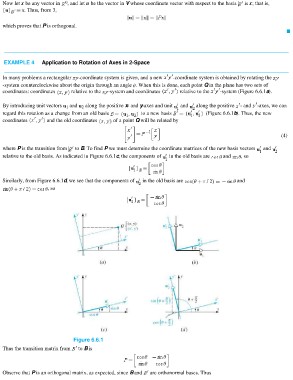
In many problems a rectangular -coordinate system is given, and a new -coordinate system is obtained by rotating the

-system counterclockwise about the origin through an angle . When this is done, each point Q in the plane has two sets of

coordinates: coordinates  relative to the -system and coordinates                    relative to the -system (Figure 6.6.1a).

By introducing unit vectors and along the positive x- and y-axes and unit and        along the positive - and -axes, we can
                                                                                          (Figure 6.6.1b). Thus, the new
regard this rotation as a change from an old basis  to a new basis

coordinates  and the old coordinates                of a point Q will be related by

                                                                                                                               (4)

where P is the transition from to B. To find P we must determine the coordinate matrices of the new basis vectors and
relative to the old basis. As indicated in Figure 6.6.1c, the components of in the old basis are and , so

Similarly, from Figure 6.6.1d, we see that the components of in the old basis are             and
                         , so

                                       Figure 6.6.1
Thus the transition matrix from to B is

Observe that P is an orthogonal matrix, as expected, since B and are orthonormal bases. Thus

