


Page 526 - Elementary_Linear_Algebra_with_Applications_Anton__9_edition
P. 526
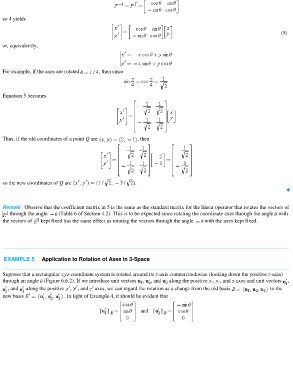
so 4 yields

                                                                                                  (5)

or, equivalently,

For example, if the axes are rotated           , then since

Equation 5 becomes

Thus, if the old coordinates of a point Q are                   , then

so the new coordinates of Q are                              .

Remark Observe that the coefficient matrix in 5 is the same as the standard matrix for the linear operator that rotates the vectors of
   through the angle (Table 6 of Section 4.2). This is to be expected since rotating the coordinate axes through the angle with

the vectors of kept fixed has the same effect as rotating the vectors through the angle with the axes kept fixed.

EXAMPLE 5 Application to Rotation of Axes in 3-Space

Suppose that a rectangular -coordinate system is rotated around its z-axis counterclockwise (looking down the positive z-axis)  ,
through an angle (Figure 6.6.2). If we introduce unit vectors , , and along the positive x-, y-, and z-axes and unit vectors

, and along the positive , , and axes, we can regard the rotation as a change from the old basis  to the

new basis           . In light of Example 4, it should be evident that

