


Page 553 - Elementary_Linear_Algebra_with_Applications_Anton__9_edition
P. 553
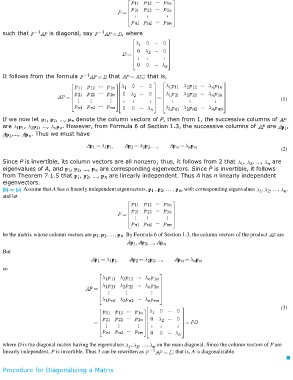
such that  is diagonal, say           , where

It follows from the formula  that              ; that is,

                                                                                                    (1)

If we now let , , …, denote the column vectors of P, then from 1, the successive columns of                           ,
are , , …, . However, from Formula 6 of Section 1.3, the successive columns of are

    ,…, . Thus we must have

                                                                                                    (2)

Since P is invertible, its column vectors are all nonzero; thus, it follows from 2 that , , …, are                    ,
eigenvalues of A, and , , …, are corresponding eigenvectors. Since P is invertible, it follows
from Theorem 7.1.5 that , , …, are linearly independent. Thus A has n linearly independent
eigenvectors.

           Assume that A has n linearly independent eigenvectors, , , … , , with corresponding eigenvalues , , …,

and let

be the matrix whose column vectors are , , …, . By Formula 6 of Section 1.3, the column vectors of the product are
But
so

                                                                                                    (3)

where D is the diagonal matrix having the eigenvalues , , …, on the main diagonal. Since the column vectors of P are

linearly independent, P is invertible. Thus 3 can be rewritten as  ; that is, A is diagonalizable.

Procedure for Diagonalizing a Matrix

