


Page 557 - Elementary_Linear_Algebra_with_Applications_Anton__9_edition
P. 557
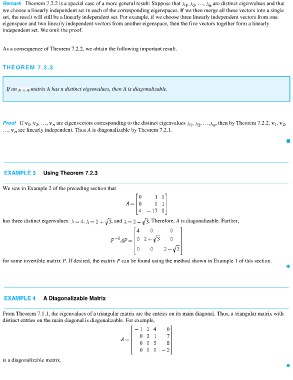
Remark Theorem 7.2.2 is a special case of a more general result: Suppose that , , …, are distinct eigenvalues and that
we choose a linearly independent set in each of the corresponding eigenspaces. If we then merge all these vectors into a single
set, the result will still be a linearly independent set. For example, if we choose three linearly independent vectors from one
eigenspace and two linearly independent vectors from another eigenspace, then the five vectors together form a linearly
independent set. We omit the proof.
As a consequence of Theorem 7.2.2, we obtain the following important result.
THEOREM 7.2.3

  If an matrix A has n distinct eigenvalues, then A is diagonalizable.

Proof If , , …, are eigenvectors corresponding to the distinct eigenvalues , , …, , then by Theorem 7.2.2, , ,
…, are linearly independent. Thus A is diagonalizable by Theorem 7.2.1.

EXAMPLE 3 Using Theorem 7.2.3
We saw in Example 2 of the preceding section that

has three distinct eigenvalues: , , and . Therefore, A is diagonalizable. Further,

for some invertible matrix P. If desired, the matrix P can be found using the method shown in Example 1 of this section.

EXAMPLE 4 A Diagonalizable Matrix
From Theorem 7.1.1, the eigenvalues of a triangular matrix are the entries on its main diagonal. Thus, a triangular matrix with
distinct entries on the main diagonal is diagonalizable. For example,

is a diagonalizable matrix.

