


Page 558 - Elementary_Linear_Algebra_with_Applications_Anton__9_edition
P. 558
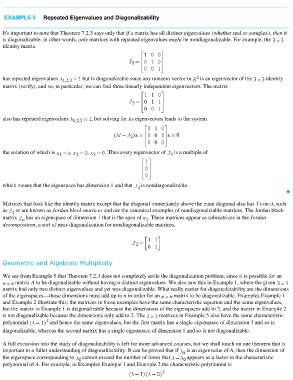
EXAMPLE 5 Repeated Eigenvalues and Diagonalizability

It's important to note that Theorem 7.2.3 says only that if a matrix has all distinct eigenvalues (whether real or complex), then it
is diagonalizable; in other words, only matrices with repeated eigenvalues might be nondiagonalizable. For example, the
identity matrix

has repeated eigenvalues       but is diagonalizable since any nonzero vector in is an eigenvector of the       identity

matrix (verify), and so, in particular, we can find three linearly independent eigenvectors. The matrix

also has repeated eigenvalues  , but solving for its eigenvectors leads to the system

the solution of which is , , . Thus every eigenvector of is a multiple of

which means that the eigenspace has dimension 1 and that is nondiagonalizable.

Matrices that look like the identity matrix except that the diagonal immediately above the main diagonal also has 1's on it, such
as or are known as Jordan block matrices and are the canonical examples of nondiagonalizable matrices. The Jordan block
matrix has an eigenspace of dimension 1 that is the span of . These matrices appear as submatrices in the Jordan
decomposition, a sort of near-diagonalization for nondiagonalizable matrices.

Geometric and Algebraic Multiplicity

We see from Example 5 that Theorem 7.2.3 does not completely settle the diagonalization problem, since it is possible for an
      matrix A to be diagonalizable without having n distinct eigenvalues. We also saw this in Example 1, where the given

matrix had only two distinct eigenvalues and yet was diagonalizable. What really matter for diagonalizability are the dimensions
of the eigenspaces—those dimensions must add up to n in order for an matrix to be diagonalizable. Examples Example 1
and Example 2 illustrate this; the matrices in those examples have the same characteristic equation and the same eigenvalues,
but the matrix in Example 1 is diagonalizable because the dimensions of the eigenspaces add to 3, and the matrix in Example 2
is not diagonalizable because the dimensions only add to 2. The matrices in Example 5 also have the same characteristic

polynomial  and hence the same eigenvalues, but the first matrix has a single eigenspace of dimension 3 and so is

diagonalizable, whereas the second matrix has a single eigenspace of dimension 1 and so is not diagonalizable.

A full excursion into the study of diagonalizability is left for more advanced courses, but we shall touch on one theorem that is

important to a fuller understanding of diagonalizability. It can be proved that if is an eigenvalue of A, then the dimension of

the eigenspace corresponding to cannot exceed the number of times that  appears as a factor in the characteristic

polynomial of A. For example, in Examples Example 1 and Example 2 the characteristic polynomial is

