


Page 556 - Elementary_Linear_Algebra_with_Applications_Anton__9_edition
P. 556
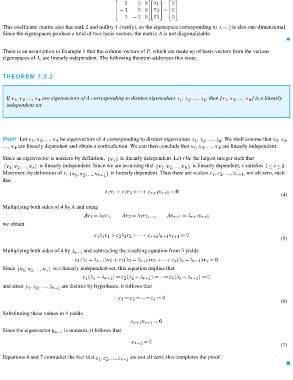
This coefficient matrix also has rank 2 and nullity 1 (verify), so the eigenspace corresponding to  is also one-dimensional.
Since the eigenspaces produce a total of two basis vectors, the matrix A is not diagonalizable.

There is an assumption in Example 1 that the column vectors of P, which are made up of basis vectors from the various
eigenspaces of A, are linearly independent. The following theorem addresses this issue.

THEOREM 7.2.2

If , , …, are eigenvectors of A corresponding to distinct eigenvalues , , …, , then { , , …, } is a linearly
independent set.

Proof Let , , …, be eigenvectors of A corresponding to distinct eigenvalues , , …, . We shall assume that , ,
…, are linearly dependent and obtain a contradiction. We can then conclude that , , …, are linearly independent.

Since an eigenvector is nonzero by definition,  is linearly independent. Let r be the largest integer such that

       is linearly independent. Since we are assuming that                is linearly dependent, r satisfies           .

Moreover, by definition of r,                   is linearly dependent. Thus there are scalars , , …, , not all zero, such

that

                                                                                                                       (4)

Multiplying both sides of 4 by A and using

we obtain                                                                                                              (5)
Multiplying both sides of 4 by and subtracting the resulting equation from 5 yields

Since          is a linearly independent set, this equation implies that

and since , , …, are distinct by hypothesis, it follows that                                                           (6)
Substituting these values in 4 yields

Since the eigenvector is nonzero, it follows that

                                                                                                                       (7)

Equations 6 and 7 contradict the fact that         are not all zero; this completes the proof.

