


Page 636 - Elementary_Linear_Algebra_with_Applications_Anton__9_edition
P. 636
8.5                     The matrix of a linear operator                             depends on the basis selected for V.

SIMILARITY              One of the fundamental problems of linear algebra is to choose a basis for V

                        that makes the matrix for T as simple as possible—a diagonal or a triangular

                        matrix, for example. In this section we shall study this problem.

Simple Matrices for Linear Operators

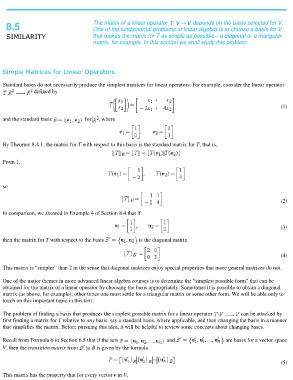
Standard bases do not necessarily produce the simplest matrices for linear operators. For example, consider the linear operator
                defined by

                                                                                                                         (1)

and the standard basis  for , where

By Theorem 8.4.1, the matrix for T with respect to this basis is the standard matrix for T; that is,
From 1,

so

                                                                                                                         (2)

In comparison, we showed in Example 4 of Section 8.4 that if

                                                                                                                         (3)

then the matrix for T with respect to the basis             is the diagonal matrix

                                                                                                                         (4)

This matrix is “simpler” than 2 in the sense that diagonal matrices enjoy special properties that more general matrices do not.

One of the major themes in more advanced linear algebra courses is to determine the “simplest possible form” that can be
obtained for the matrix of a linear operator by choosing the basis appropriately. Sometimes it is possible to obtain a diagonal
matrix (as above, for example); other times one must settle for a triangular matrix or some other form. We will be able only to
touch on this important topic in this text.

The problem of finding a basis that produces the simplest possible matrix for a linear operator       can be attacked by

first finding a matrix for T relative to any basis, say a standard basis, where applicable, and then changing the basis in a manner

that simplifies the matrix. Before pursuing this idea, it will be helpful to review some concepts about changing bases.

Recall from Formula 6 in Section 6.5 that if the sets            and                                  are bases for a vector space
V, then the transition matrix from to B is given by the formula

                                                                                                                         (5)

This matrix has the property that for every vector v in V,

