


Page 641 - Elementary_Linear_Algebra_with_Applications_Anton__9_edition
P. 641
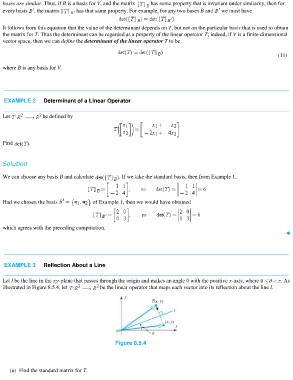
bases are similar. Thus, if B is a basis for V, and the matrix  has some property that is invariant under similarity, then for

every basis , the matrix          has that same property. For example, for any two bases B and we must have

It follows from this equation that the value of the determinant depends on T, but not on the particular basis that is used to obtain
the matrix for T. Thus the determinant can be regarded as a property of the linear operator T; indeed, if V is a finite-dimensional
vector space, then we can define the determinant of the linear operator T to be

                                                                                                                             (11)

where B is any basis for V.

EXAMPLE 2 Determinant of a Linear Operator
Let be defined by

Find .                                        . If we take the standard basis, then from Example 1,

Solution

We can choose any basis B and calculate

Had we chosen the basis              of Example 1, then we would have obtained

which agrees with the preceding computation.

EXAMPLE 3 Reflection About a Line

Let l be the line in the -plane that passes through the origin and makes an angle θ with the positive x-axis, where          . As

illustrated in Figure 8.5.4, let         be the linear operator that maps each vector into its reflection about the line l.

                                              Figure 8.5.4

(a) Find the standard matrix for T.

