


Page 638 - Elementary_Linear_Algebra_with_Applications_Anton__9_edition
P. 638
In this figure, v is first mapped into itself by the identity operator, then v is mapped into by T , then is mapped into
itself by the identity operator. All four vector spaces involved in the composition are the same (namely, V); however, the bases
for the spaces vary. Since the starting vector is v and the final vector is , the composition is the same as T; that is,

                                                                                                                                                       (7)

If, as illustrated in Figure 8.5.2, the first and last vector spaces are assigned the basis and the middle two spaces are assigned
the basis B, then it follows from 7 and Formula 15 of Section 8.4 (with an appropriate adjustment in the names of the bases) that

                                                                                                                            (8)

or, in simpler notation,

But it follows from Theorem 8.5.1 that      is the transition matrix from to B and consequently,                             (9)
matrix from B to . Thus, if we let                                                                           is the transition

                                            , then                , so 9 can be written as

In summary, we have the following theorem.
THEOREM 8.5.2

Let be a linear operator on a finite-dimensional vector space V, and let B and be bases for V . Then

                                                                                                                            (10)

where P is the transition matrix from to B.

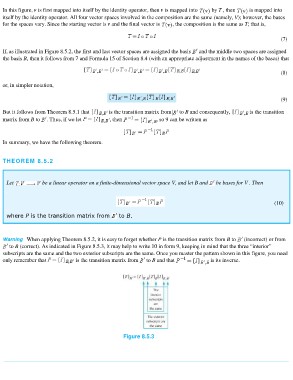
Warning When applying Theorem 8.5.2, it is easy to forget whether P is the transition matrix from B to (incorrect) or from

to B (correct). As indicated in Figure 8.5.3, it may help to write 10 in form 9, keeping in mind that the three “interior”

subscripts are the same and the two exterior subscripts are the same. Once you master the pattern shown in this figure, you need

only remember that        is the transition matrix from to B and that                       is its inverse.

                                                    Figure 8.5.3

