


Page 637 - Elementary_Linear_Algebra_with_Applications_Anton__9_edition
P. 637
(6)
That is, multiplication by P maps the coordinate matrix for v relative to into the coordinate matrix for v relative to B [see
Formula 5 in Section 6.5]. We showed in Theorem 6.5.4 that P is invertible and is the transition matrix from B to .

The following theorem gives a useful alternative viewpoint about transition matrices; it shows that the transition matrix from a
basis to a basis B can be regarded as the matrix of an identity operator.

THEOREM 8.5.1

If B and are bases for a finite-dimensional vector space V, and if  is the identity operator, then the transition

matrix from to B is    .

Proof Suppose that        and                                   are bases for V. Using the fact that  for all v in V, it

follows from Formula 4 of Section 8.4 with B and reversed that

Thus, from 5, we have     , which shows that                        is the transition matrix from to B.

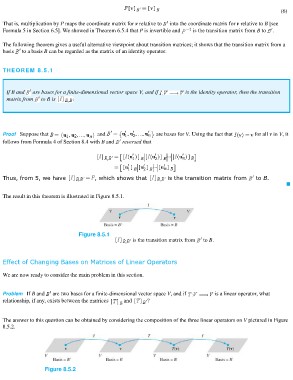
The result in this theorem is illustrated in Figure 8.5.1.

                          Figure 8.5.1

                                                            is the transition matrix from to B.

Effect of Changing Bases on Matrices of Linear Operators

We are now ready to consider the main problem in this section.

Problem If B and are two bases for a finite-dimensional vector space V, and if                   is a linear operator, what
relationship, if any, exists between the matrices and ?

The answer to this question can be obtained by considering the composition of the three linear operators on V pictured in Figure
8.5.2.

Figure 8.5.2

