


Page 706 - Elementary_Linear_Algebra_with_Applications_Anton__9_edition
P. 706
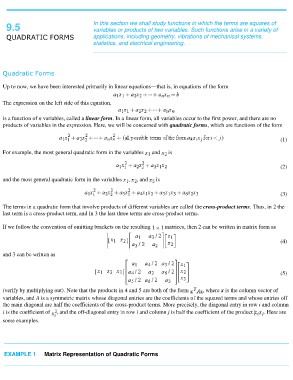
9.5                      In this section we shall study functions in which the terms are squares of
                         variables or products of two variables. Such functions arise in a variety of
QUADRATIC FORMS          applications, including geometry, vibrations of mechanical systems,
                         statistics, and electrical engineering.

Quadratic Forms

Up to now, we have been interested primarily in linear equations—that is, in equations of the form

The expression on the left side of this equation,

is a function of n variables, called a linear form. In a linear form, all variables occur to the first power, and there are no
products of variables in the expression. Here, we will be concerned with quadratic forms, which are functions of the form

                                                                                                                     (1)

For example, the most general quadratic form in the variables and is

                                                                                                                     (2)

and the most general quadratic form in the variables , , and is

                                                                                                                                                   (3)

The terms in a quadratic form that involve products of different variables are called the cross-product terms. Thus, in 2 the
last term is a cross-product term, and in 3 the last three terms are cross-product terms.

If we follow the convention of omitting brackets on the resulting matrices, then 2 can be written in matrix form as

                                                                                                                     (4)

and 3 can be written as

                                                                                                                                                   (5)

(verify by multiplying out). Note that the products in 4 and 5 are both of the form , where x is the column vector of
variables, and A is a symmetric matrix whose diagonal entries are the coefficients of the squared terms and whose entries off
the main diagonal are half the coefficients of the cross-product terms. More precisely, the diagonal entry in row i and column
i is the coefficient of , and the off-diagonal entry in row i and column j is half the coefficient of the product . Here are
some examples.

EXAMPLE 1 Matrix Representation of Quadratic Forms

