


Page 73 - Elementary_Linear_Algebra_with_Applications_Anton__9_edition
P. 73
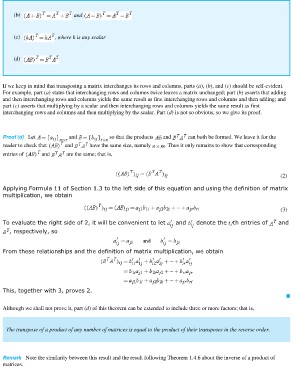
(b) and
(c) , where k is any scalar
(d)

If we keep in mind that transposing a matrix interchanges its rows and columns, parts (a), (b), and (c) should be self-evident.
For example, part (a) states that interchanging rows and columns twice leaves a matrix unchanged; part (b) asserts that adding
and then interchanging rows and columns yields the same result as first interchanging rows and columns and then adding; and
part (c) asserts that multiplying by a scalar and then interchanging rows and columns yields the same result as first
interchanging rows and columns and then multiplying by the scalar. Part (d) is not so obvious, so we give its proof.

Proof (d) Let           and so that the products      and can both be formed. We leave it for the
                      and have the same size, namely  . Thus it only remains to show that corresponding
reader to check that  are the same; that is,

entries of     and

                                                                                                                                                     (2)
Applying Formula 11 of Section 1.3 to the left side of this equation and using the definition of matrix
multiplication, we obtain

                                                                                                                                                     (3)
To evaluate the right side of 2, it will be convenient to let and denote the th entries of and

   , respectively, so

From these relationships and the definition of matrix multiplication, we obtain

This, together with 3, proves 2.
Although we shall not prove it, part (d) of this theorem can be extended to include three or more factors; that is,

 The transpose of a product of any number of matrices is equal to the product of their transposes in the reverse order.

Remark Note the similarity between this result and the result following Theorem 1.4.6 about the inverse of a product of
matrices.

