


Page 887 - Elementary_Linear_Algebra_with_Applications_Anton__9_edition
P. 887
Whereas the natural spline tends to produce an interpolating curve that is flat at the endpoints, the cubic runout spline has the
opposite tendency: it produces a curve with pronounced curvature at the endpoints. If neither behavior is desired, the parabolic
runout spline is a reasonable compromise.

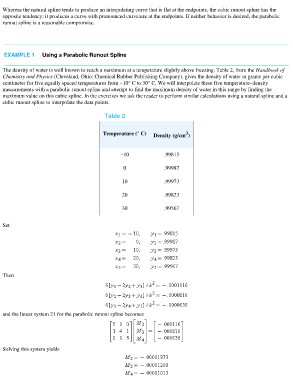
EXAMPLE 1 Using a Parabolic Runout Spline
The density of water is well known to reach a maximum at a temperature slightly above freezing. Table 2, from the Handbook of
Chemistry and Physics (Cleveland, Ohio: Chemical Rubber Publishing Company), gives the density of water in grams per cubic
centimeter for five equally spaced temperatures from −10° C to 30° C. We will interpolate these five temperature–density
measurements with a parabolic runout spline and attempt to find the maximum density of water in this range by finding the
maximum value on this cubic spline. In the exercises we ask the reader to perform similar calculations using a natural spline and a
cubic runout spline to interpolate the data points.

                                                   Table 2

                                                       Temperature (° C) Density (g/cm3)
                                                                 −10 .99815
                                                                   0 .99987
                                                                  10 .99973
                                                                  20 .99823
                                                                  30 .99567

Set

Then

and the linear system 21 for the parabolic runout spline becomes

Solving this system yields

