


Page 890 - Elementary_Linear_Algebra_with_Applications_Anton__9_edition
P. 890
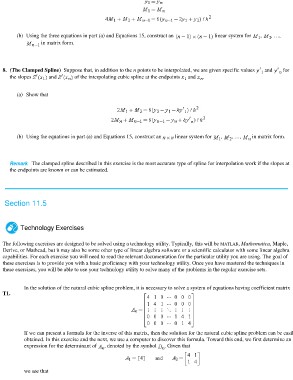
(b) Using the three equations in part (a) and Equations 15, construct an  linear system for , , …,
             in matrix form.

8. (The Clamped Spline) Suppose that, in addition to the n points to be interpolated, we are given specific values and for
   the slopes and of the interpolating cubic spline at the endpoints and .

       (a) Show that

       (b) Using the equations in part (a) and Equations 15, construct an linear system for , , …, in matrix form.

   Remark The clamped spline described in this exercise is the most accurate type of spline for interpolation work if the slopes at
   the endpoints are known or can be estimated.

Section 11.5

        Technology Exercises

The following exercises are designed to be solved using a technology utility. Typically, this will be MATLAB, Mathematica, Maple,
Derive, or Mathcad, but it may also be some other type of linear algebra software or a scientific calculator with some linear algebra
capabilities. For each exercise you will need to read the relevant documentation for the particular utility you are using. The goal of
these exercises is to provide you with a basic proficiency with your technology utility. Once you have mastered the techniques in
these exercises, you will be able to use your technology utility to solve many of the problems in the regular exercise sets.

           In the solution of the natural cubic spline problem, it is necessary to solve a system of equations having coefficient matrix
T1.

           If we can present a formula for the inverse of this matrix, then the solution for the natural cubic spline problem can be easil
           obtained. In this exercise and the next, we use a computer to discover this formula. Toward this end, we first determine an
           expression for the determinant of , denoted by the symbol . Given that

           we see that

