


Page 42 - Lecture Notes DCC3113
P. 42
The different between bitumen and tar
Table 3-3: The different between bitumen and tar
Bitumen Tar
viscous liquid/solid
black or brown in color adhesive quality
having adhesive qualities, a product of coal (black or dark brown rock
Consisting essentially of hydrocarbons, derived consisting mainly of carbonized plant matter,
from petroleum or occuring naturally and soluble found mainly in underground deposits)
in carbon disulphate (80-85% C, 10% H)
3.1.2 The types and their objectives of tests on road construction materials:
The types of tests on materials
The tests for evaluate on Aggregates Properties are:
i. Aggregate Crushing Value (BS 812:Part 110:1990)
ii. Ten Percent Fine Value (BS 812:Part 111:1990)
iii. Aggregate Impact Value (BS 812:Part 112 :1990)
iv. Los Angeles Abrasion (ASTM C: 131-81)
v. Soundness (AASHTO-T :104)
vi. Flakiness Index (BS 812:Section 105.1 :1989)
vii. Elongation Index (BS 812 :part 1 :1975)
viii. Water Absorption and Specific Gravity (BS 812:part 2:1975)
ix. Coating and Striping (AASHTO-T :182)
x. Polished Stone Value (BS 812:Part 14:1989)
xi. Sieve analysis (BS 1377:Part 2:1990)
The objectives of tests on road construction materials
The objectives of test for aggregates are:
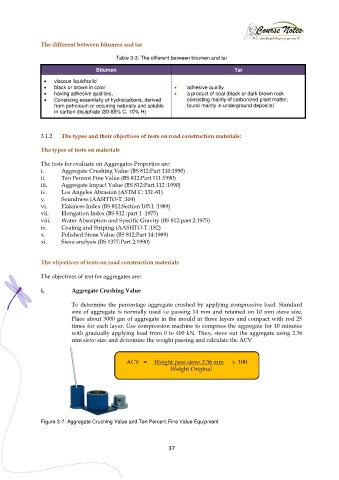
i. Aggregate Crushing Value
To determine the percentage aggregate crushed by applying compressive load. Standard
size of aggregate is normally used i.e passing 14 mm and retained on 10 mm sieve size.
Place about 3000 gm of aggregate in the mould in three layers and compact with rod 25
times for each layer. Use compression machine to compress the aggregate for 10 minutes
with gradually applying load from 0 to 400 kN. Then, sieve out the aggregate using 2.36
mm sieve size and determine the weight passing and calculate the ACV
Figure 3-7: Aggregate Crushing Value and Ten Percent Fine Value Equipment
37

