


Page 82 - Lecture Notes DCC3113
P. 82
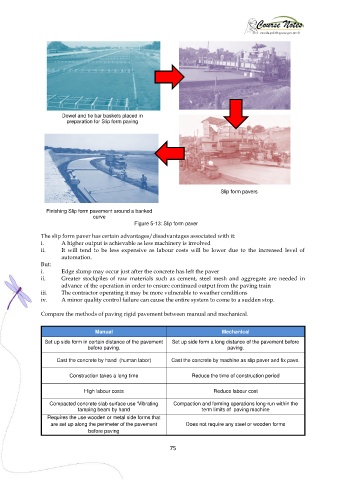
Dowel and tie bar baskets placed in
                          preparation for Slip form paving


                                                                               Slip form pavers


                 Finishing Slip form pavement around a banked
                                  curve

                                                Figure 5-13: Slip form paver

                                                         Work
               The slip form paver has certain advantages/disadvantages associated with it:
               i.      A higher output is achievable as less machinery is involved
               ii.     It  will  tend  to  be  less  expensive  as  labour  costs  will  be  lower  due  to  the  increased  level  of

                       automation.
               But:
               i.      Edge slump may occur just after the concrete has left the paver
               ii.     Greater  stockpiles  of  raw  materials  such  as  cement,  steel  mesh  and  aggregate  are  needed  in

                       advance of the operation in order to ensure continued output from the paving train
               iii.    The contractor operating it may be more vulnerable to weather conditions

               iv.     A minor quality control failure can cause the entire system to come to a sudden stop.

               Compare the methods of paving rigid pavement between manual and mechanical.


                                  Manual                                       Mechanical

                 Set up side form in certain distance of the pavement   Set up side form a long distance of the pavement before
                                before paving.                                   paving.

                     Cast the concrete by hand  (human labor)   Cast the concrete by machine as slip paver and fix pave.

                         Construction takes a long time             Reduce the time of construction period

                               High labour costs                            Reduce labour cost

                  Compacted concrete slab surface use 'Vibrating   Compaction and forming operations long-run within the
                            tamping beam by hand                        term limits of  paving machine

                  Requires the use wooden or metal side forms that
                   are set up along the perimeter of the pavement   Does not require any steel or wooden forms

                                before paving

                                                             75

