


Page 78 - Lecture Notes DCC3113
P. 78
Joined reinforced Concrete Pavement (JRCP)
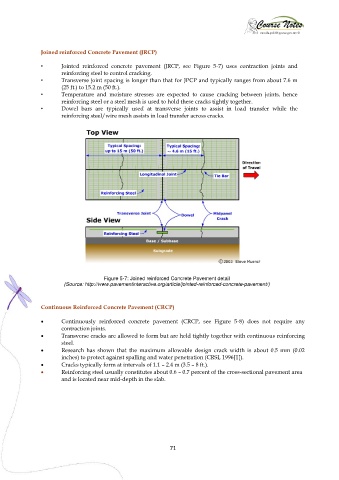
• Jointed reinforced concrete pavement (JRCP, see Figure 5-7) uses contraction joints and
reinforcing steel to control cracking.
• Transverse joint spacing is longer than that for JPCP and typically ranges from about 7.6 m
(25 ft.) to 15.2 m (50 ft.).
• Temperature and moisture stresses are expected to cause cracking between joints, hence
reinforcing steel or a steel mesh is used to hold these cracks tightly together.
• Dowel bars are typically used at transverse joints to assist in load transfer while the
reinforcing steel/wire mesh assists in load transfer across cracks.
Figure 5-7: Joined reinforced Concrete Pavement detail
(Source: http://www.pavementinteractive.org/article/jointed-reinforced-concrete-pavement/)
Continuous Reinforced Concrete Pavement (CRCP)
Continuously reinforced concrete pavement (CRCP, see Figure 5-8) does not require any
contraction joints.
Transverse cracks are allowed to form but are held tightly together with continuous reinforcing
steel.
Research has shown that the maximum allowable design crack width is about 0.5 mm (0.02
inches) to protect against spalling and water penetration (CRSI, 1996[1]).
Cracks typically form at intervals of 1.1 – 2.4 m (3.5 – 8 ft.).
Reinforcing steel usually constitutes about 0.6 – 0.7 percent of the cross-sectional pavement area
and is located near mid-depth in the slab.
71

