


Page 80 - Lecture Notes DCC3113
P. 80
5.1.4   Differentiate the methods of paving rigid pavement

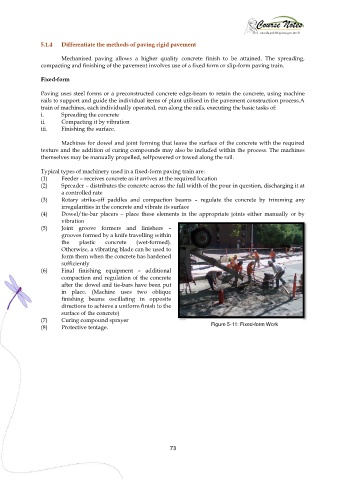
                       Mechanised  paving  allows  a  higher  quality  concrete  finish  to  be  attained.  The  spreading,
               compacting and finishing of the pavement involves use of a fixed form or slip-form paving train.

               Fixed-form

               Paving uses steel forms or a preconstructed concrete edge-beam to retain the concrete, using machine
               rails to support and guide the individual items of plant utilised in the pavement construction process.A
               train of machines, each individually operated, run along the rails, executing the basic tasks of:
               i.      Spreading the concrete
               ii.     Compacting it by vibration
               iii.    Finishing the surface.

                       Machines for dowel and joint forming that leave the surface of the concrete with the required
               texture and the addition of curing compounds may also be included within the process. The machines
               themselves may be manually propelled, selfpowered or towed along the rail.

               Typical types of machinery used in a fixed-form paving train are:
               (1)     Feeder – receives concrete as it arrives at the required location
               (2)     Spreader – distributes the concrete across the full width of the pour in question, discharging it at
                       a controlled rate
               (3)     Rotary  strike-off  paddles  and  compaction  beams  –  regulate  the  concrete  by  trimming  any
                       irregularities in the concrete and vibrate its surface
               (4)     Dowel/tie-bar  placers  –  place  these  elements  in  the  appropriate  joints  either  manually  or  by
                       vibration
               (5)     Joint  groove  formers  and  finishers  –
                       grooves formed by a knife travelling within
                       the   plastic   concrete   (wet-formed).
                       Otherwise, a vibrating blade can be used to
                       form them when the concrete has hardened
                       sufficiently
               (6)     Final  finishing  equipment  –  additional
                       compaction and regulation of the concrete
                       after the dowel and tie-bars have been put
                       in  place.  (Machine  uses  two  oblique
                       finishing  beams  oscillating  in  opposite
                       directions to achieve a uniform finish to the
                       surface of the concrete)
               (7)     Curing compound sprayer
               (8)     Protective tentage.                                 Figure 5-11: Fixed-form Work


                                                             73

