


Page 77 - Lecture Notes DCC3113
P. 77
Warping joints are required in plain unreinforced concrete slabs only. They permit small
angular movements to occur between adjacent concrete slabs. Warping stresses are very likely to occur
in long narrow slabs. They are required in unreinforced slabs only, as in reinforced slabs the warping is
kept in check by the reinforcing bars. They are simply a sealed break or discontinuity in the concrete slab
itself, with tie-bars used to restrict any widening and hold the sides together.
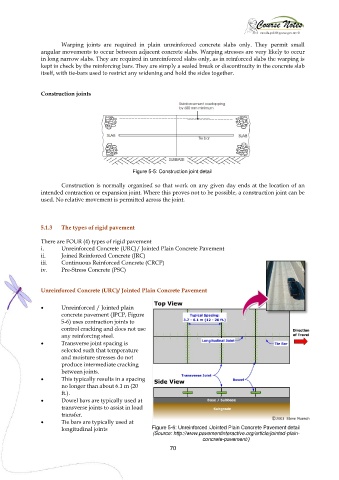
Construction joints
Figure 5-5: Construction joint detail
Work
Construction is normally organised so that work on any given day ends at the location of an
intended contraction or expansion joint. Where this proves not to be possible, a construction joint can be
used. No relative movement is permitted across the joint.
5.1.3 The types of rigid pavement
There are FOUR (4) types of rigid pavement
i. Unreinforced Concrete (URC)/ Jointed Plain Concrete Pavement
ii. Joined Reinforced Concrete (JRC)
iii. Continuous Reinforced Concrete (CRCP)
iv. Pre-Stress Concrete (PSC)
Unreinforced Concrete (URC)/ Jointed Plain Concrete Pavement
Unreinforced / Jointed plain
concrete pavement (JPCP, Figure
5-6) uses contraction joints to
control cracking and does not use
any reinforcing steel.
Transverse joint spacing is
selected such that temperature
and moisture stresses do not
produce intermediate cracking
between joints.
This typically results in a spacing
no longer than about 6.1 m (20
ft.).
Dowel bars are typically used at
transverse joints to assist in load
transfer.
Tie bars are typically used at
longitudinal joints Figure 5-6: Unreinforced /Jointed Plain Concrete Pavement detail
(Source: http://www.pavementinteractive.org/article/jointed-plain-
concrete-pavement/)
70
Work

