


Page 98 - Lecture Notes DCC3113
P. 98
FLEXIBLE PAVEMENT DESIGN


               7.1      THE BASIC DESIGN OF FLEXIBLE PAVEMENT


               Pavement Thickness Design is the determination of required thickness of various pavement layers to
               protect a given soil condition for a given wheel load

               Aim: to design a structure that will ensure that the transmitted stresses are sufficiently reduced and do
               not exceed the capacity of the underlying subgrade.


               7.1.1    The factors that are considered in designing the thickness of flexible pavement.

               a.      Failure criteria
               b.      Traffic loading
               c.      Traffic decaying power
               d.      Environmental effect

               Failure criteria

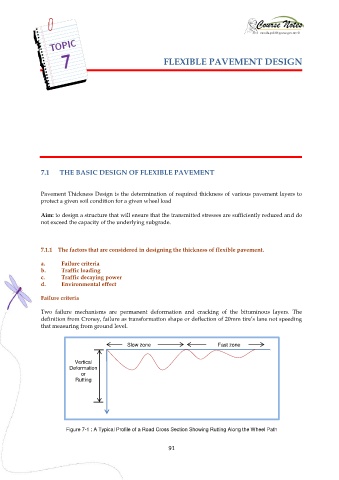
               Two  failure  mechanisms  are  permanent  deformation  and  cracking  of  the  bituminous  layers.  The
               definition from Croney, failure as transformation shape or deflection of 20mm tire’s lane not speeding
               that measuring from ground level.


                                              Slow zone                                               Fast zone


                           Vertical
                         Deformation
                              or
                           Rutting


                        Figure 7-1 : A Typical Profile of a Road Cross Section Showing Rutting Along the Wheel Path


                                                            91

