


Page 101 - Lecture Notes DCC3113
P. 101
b.      Design life

               The  design  life  refers  to  the  span  of  time  between  the  initial  opening  to  traffic  until  the  pavement
               requires a strengthening overlay. The design life should not be confused with the pavement life since
               the pavement life can be extended by routine maintenance and rehabilitation. The typical design life is
               10 years.

               The design life on JKR Design Method is suggested for 10 years. The design life begins from the road
               starts in use for traffic until the maintenance is required.


               c.      Sub-grade condition

               In case of varying CBR for 1m depth of sub-grade, mean CBR is determined as follows:

                                                                                  3
                                                                        1/3
                       CBRm   =      [(h1CBR1  1/3  + h2CBR2   + … + hnCBRn  ) / (1000)]
                                                         1/3

               Where:
                       CBRm                        =       mean CBR for that location
                       CBR1, CBR2, … CBRn   =      CBR of soil strata
                       h1, h2, … hn                =       thickness of soil strata (mm)
                       h1 + h2 + … + hn            =       1000 mm

               A minimum CBR of 5% is recommended for pavements that have to support traffic volumes
               corresponding to Traffic Classes T2 through T5.

               For road pavements that designed for large volumes traffic (Traffic Classes T4 and T5), a minimum sub-
               grade strength corresponding to CBR of 12% is recommended. For pavements design purposes, the use
               of average CBR or sub-grade modulus test results is not recommended.


               d.      Drainage

               To ensure the safety of the travelling public, careful consideration must be given to remove the runoff
               from the roadway through the structure of the pavement drainage facilities.


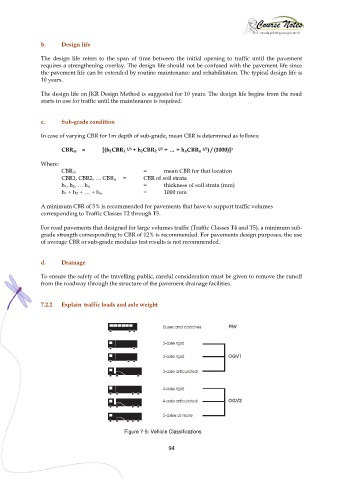
               7.2.2   Explain  traffic loads and axle weight


                                             Figure 7-5: Vehicle Classifications


                                                            94

