


Page 99 - Lecture Notes DCC3113
P. 99
Traffic Loadings
Protection of the sub-grade from the loading imposed by traffic is one of the primary functions of a
pavement structure. The designer must provide a pavement that can withstand a large number of
repeated applications of a variable-magnitude loading. Traffic loading comprise of :
i. Tire load and pressure
ii. Axle and wheel configurations
iii. Load repetition
iv. Traffic distribution
v. Vehicle Speed
vi. Equivalent Standard Axle (ESA)
Traffic Decaying Power
Every time an axle load acts on a pavement, damage is inflicted onto the pavement. Real traffic
composition is a mixture of varying weights & numbers of axles. According to this concept, one
application of standard axle load inflicts one unit of damage to the pavement.
Environmental Effect
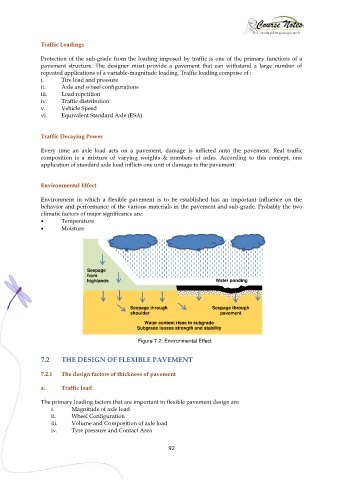
Environment in which a flexible pavement is to be established has an important influence on the
behavior and performance of the various materials in the pavement and sub-grade. Probably the two
climatic factors of major significance are:
Temperature
Moisture
Seepage
from
highlands Water ponding
Seepage through Seepage through
shoulder pavement
Water content rises in subgrade
Subgrade looses strength and stability
Figure 7-2: Environmental Effect
7.2 THE DESIGN OF FLEXIBLE PAVEMENT
7.2.1 The design factors of thickness of pavement
a. Traffic load
The primary loading factors that are important in flexible pavement design are
i. Magnitude of axle load
ii. Wheel Configuration
iii. Volume and Composition of axle load
iv. Tyre pressure and Contact Area
92

