


Page 136 - C:\Users\trainee\AppData\Local\Temp\msoEAA3.tmp
P. 136
Fundamentals of Stress and Vibration                1. Mathematics for Structural mechanics
                 [A Practical guide for aspiring Designers / Analysts]

               However, from elementary trigonometry, we know that, the area of a triangle whose sides and
               included angle are known is given by:

                                           1

                Area of the triangle  ACD  =  a    b sinθ
                                           2
               This proves equation (1.30).

               Vector products could also be represented in the matrix form, as follows:


                         i    j   k

                a   × b =  a x  a y  a
                                   z
                         b x  b y  b z
               Taking determinant of the above matrix, we get:

                             k
                    i    j
               det  a x  a y  a
                             z
                    b x  b y  b z

               = i   a b − a b   − j   a b − a b   + k  a b − a b
                     y z
                                                             y x
                           z y
                                            z x
                                     x z
                                                      x y
               The above expression is the vector whose magnitude is given by:   a    b sinθ


               Which is the area of the parallelogram, whose two sides the vectors  a   and b  themselves.

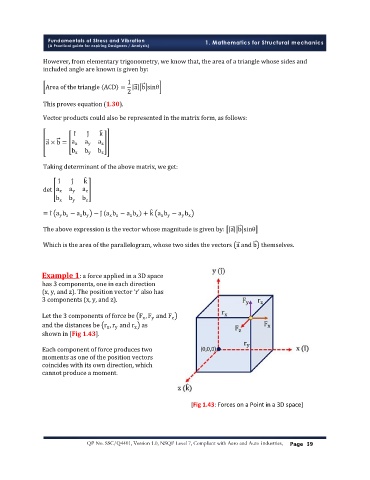
               Example 1: a force applied in a 3D space
               has 3 components, one in each direction
               (x, y, and z). The position vector ‘r’ also has
               3 components (x, y, and z).

               Let the 3 components of force be  F , F  and F
                                                   y
                                                x
                                                          z
               and the distances be  r , r  and r   as
                                              z
                                    x
                                       y
               shown in [Fig 1.43].

               Each component of force produces two
               moments as one of the position vectors
               coincides with its own direction, which
               cannot produce a moment.


                                                                [Fig 1.43: Forces on a Point in a 3D space]


                              QP No. SSC/Q4401, Version 1.0, NSQF Level 7, Compliant with Aero and Auto Industries,   Page 39

