


Page 133 - C:\Users\trainee\AppData\Local\Temp\msoEAA3.tmp
P. 133
Fundamentals of Stress and Vibration
[A Practical guide for aspiring Designers / Analysts] 1. Mathematics for Structural mechanics
ͳǤ
ǡ
ǡ
ϐ
Ǥ
-
ȏ ȐǤ
ǡ
ǡ -
ǡ
Ǥ
ǡ ȏ ͳǤ͵ͻȐǤ
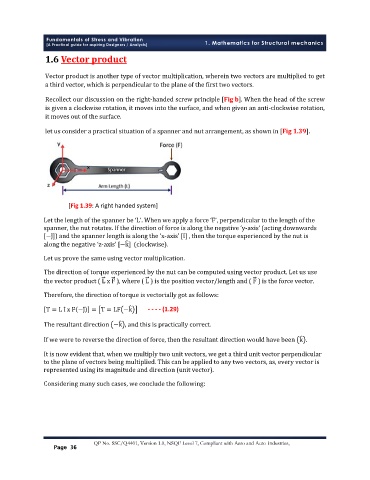
[Fig 1.39: A right handed system]
Let the length of the spanner be ‘L’. When we apply a force ‘F’, perpendicular to the length of the
spanner, the nut rotates. If the direction of force is along the negative ‘y-axis’ (acting downwards
[−j ]) and the spanner length is along the ‘x-axis’ [i ] , then the torque experienced by the nut is
along the negative ‘z-axis’ [−k] (clockwise).
Let us prove the same using vector multiplication.
The direction of torque experienced by the nut can be computed using vector product. Let us use
the vector product ( L x F ), where ( L ) is the position vector/length and ( F ) is the force vector.
Therefore, the direction of torque is vectorially got as follows:
T = L i x F −j = T = LF −k - - - - (1.29)
The resultant direction −k , and this is practically correct.
If we were to reverse the direction of force, then the resultant direction would have been k .
It is now evident that, when we multiply two unit vectors, we get a third unit vector perpendicular
to the plane of vectors being multiplied. This can be applied to any two vectors, as, every vector is
represented using its magnitude and direction (unit vector).
Considering many such cases, we conclude the following:
QP No. SSC/Q4401, Version 1.0, NSQF Level 7, Compliant with Aero and Auto Industries,
Page 36

