


Page 158 - C:\Users\trainee\AppData\Local\Temp\msoEAA3.tmp
P. 158
Fundamentals of Stress and Vibration 1. Mathematics for Structural mechanics
[A Practical guide for aspiring Designers / Analysts]
If the involute were to originate from the horizontal instead of an arbitrary angle (α), meaning
(α = 0) , then, the equations for (x) and (y) are given as:
x = R cosθ + R θ sinθ and y = R sinθ − R θ cos θ
b
b
b
b
The coordinates (x, y) go to form the expression for the involute curve.
ͳǤͳͳǤ͵
ȏ ͳǤ͵ȐǤ
ǡ
Ǥ
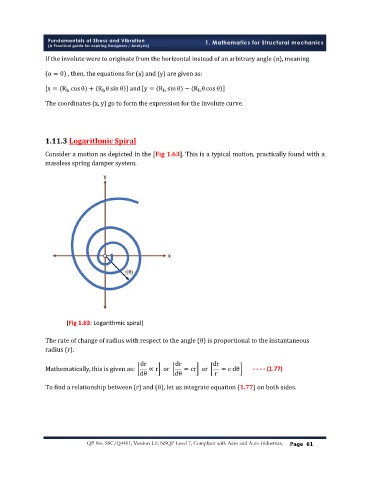
[Fig 1.63: Logarithmic spiral]
The rate of change of radius with respect to the angle (θ) is proportional to the instantaneous
radius (r).
dr dr dr
Mathematically, this is given as: ∝ r or = cr or = c dθ - - - - (1.77)
dθ dθ r
To find a relationship between (r) and (θ), let us integrate equation (1.77) on both sides.
QP No. SSC/Q4401, Version 1.0, NSQF Level 7, Compliant with Aero and Auto Industries, Page 61

