


Page 5 - C:\Users\trainee\AppData\Local\Temp\msoEAA3.tmp
P. 5
Document Title
Fundamentals of Stress and Vibration 2. Engineering Mechanics Chapter
[A Practical guide for aspiring Designers / Analysts]
Since (x = 1), we have (z = 2)
2
This given us the relationship: s = at - - - - (2.3)
It is to be noted that, the actual relationship between displacement, acceleration and time, for a
straight line motion, is given by:
1
2
s = at
2
The limitation of this approach is that, the constant (1/2) cannot be computed.
ʹǣ
ǡ
ǡ ǡ ȋ Ȍ
Ǥ
a b
c d
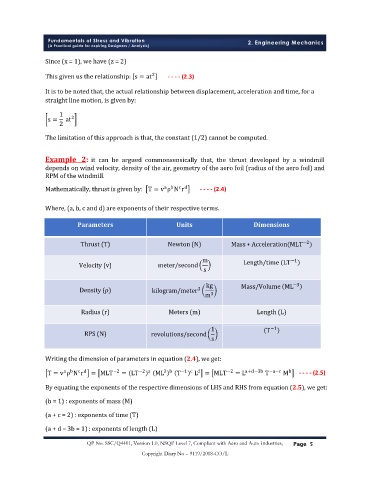
Mathematically, thrust is given by: T = v ρ N r - - - - (2.4)
ǡ ȋǡ ǡ
Ȍ
Ǥ
Parameters Units Dimensions
Thrust (T) Newton (N) Mass ∗ Acceleration(MLT −2 )
m −1
Velocity (v) meter/second Length/time LT
s
−3
kg Mass/Volume ML
Density (ρ) kilogram/meter
3
m 3
Radius (r) Meters (m) Length (L)
1 (T −1 )
RPS (N) revolutions/second
s
Writing the dimension of parameters in equation (2.4), we get:
b
c d
a b
L = MLT
ML T
T = v ρ N r = MLT −2 = LT −2 a 3 b −1 c d −2 = L a+d−3b T −a−c M - - - - (2.5)
By equating the exponents of the respective dimensions of LHS and RHS from equation (2.5), we get:
(b = 1) : exponents of mass (M)
(a + c = 2) : exponents of time (T)
(a + d – 3b = 1) : exponents of length (L)
QP No. SSC/Q4401, Version 1.0, NSQF Level 7, Compliant with Aero and Auto Industries, P
Page 5 age 5
Copyright Diary No – 9119/2018-CO/L

