


Page 7 - C:\Users\trainee\AppData\Local\Temp\msoEAA3.tmp
P. 7
Document Title
                 Fundamentals of Stress and Vibration                              2. Engineering Mechanics   Chapter
                 [A Practical guide for aspiring Designers / Analysts]

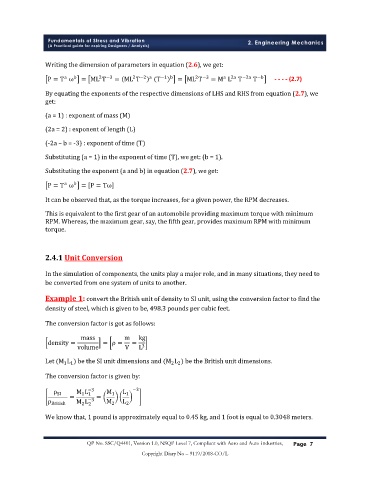
                Writing the dimension of parameters in equation (2.6), we get:


                         b
                                                                           a
                                                                             2a
                      a
                                  2 −3
                                             2 −2 a
                 P = T  ω   =  ML T    =  ML T        T −1 b      2 −3  = M  L  T −2a  T −b     - - - - (2.7)
                                                            =  ML T

                By equating the exponents of the respective dimensions of LHS and RHS from equation (2.7), we

                get:

                (a = 1) : exponent of mass (M)
                  (2a = 2) : exponent of length (L)
                  (-2a – b = -3) : exponent of time (T)
                  Substituting (a = 1) in the exponent of time (T), we get: (b = 1).
                  Substituting the exponent (a and b) in equation (2.7), we get:

                      a
                 P = T  ω   =  P = Tω
                         b

                It can be observed that, as the torque increases, for a given power, the RPM decreases.

                This is equivalent to the first gear of an automobile providing maximum torque with minimum

                RPM. Whereas, the maximum gear, say, the fifth gear, provides maximum RPM with minimum
                torque.


                2.4.1 Unit Conversion


                In the simulation of components, the units play a major role, and in many situations, they need to

                be converted from one system of units to another.

                Example 1: convert the British unit of density to SI unit, using the conversion factor to find the
                  density of steel, which is given to be, 498.3 pounds per cubic feet.

                  The conversion factor is got as follows:

                            mass          m    kg
                 density =          =  ρ =   =
                           volume         V    L 3

                Let (M L ) be the SI unit dimensions and (M L ) be the British unit dimensions.
                                                          2 2
                      1 1

                The conversion factor is given by:

                   ρ SI   M L −3    M 1   L 1  −3
                            1 1
                        =        =
                 ρ British  M L −3  M 2   L 2
                            2 2

                We know that, 1 pound is approximately equal to 0.45 kg, and 1 foot is equal to 0.3048 meters.


                              QP No. SSC/Q4401, Version 1.0, NSQF Level 7, Compliant with Aero and Auto Industries,   P
                                                                                                  Page 7 age 7
                                                Copyright Diary No – 9119/2018-CO/L

