


Page 63 - C:\Users\trainee\AppData\Local\Temp\msoEAA3.tmp
P. 63
Document Title
                 Fundamentals of Stress and Vibration                              2. Engineering Mechanics   Chapter
                 [A Practical guide for aspiring Designers / Analysts]


                    6)  Certain metals are self-lubricating (example – cast iron), wherein, the friction is reduced
                        as the surface wears.
                    7)  Friction coefficient for rubber components and joints are susceptible to variation and
                        hence must be carefully assumed.
                    8)  Friction coefficient varies significantly in vibratory environments due to variation in
                        contact force.
                    9)  Presence of oil in a bolted joint could lead to 30% variation in preload. Incidentally, about
                        80 to 90% of the preload provided to a joint is consumed by friction.
                    10) Super polishing of surfaces leads to an increase in friction coefficient
                        (example – slip gauges).

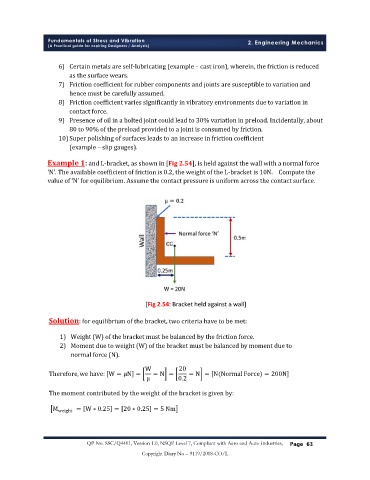
                 Example 1: and L-bracket, as shown in [Fig 2.54], is held against the wall with a normal force
                 ‘N’. The available coefficient of friction is 0.2, the weight of the L-bracket is 10N.    Compute the
                 value of ‘N’ for equilibrium. Assume the contact pressure is uniform across the contact surface.


                                                 [Fig 2.54: Bracket held against a wall]

                 Solution: for equilibrium of the bracket, two criteria have to be met:


                     1)  Weight (W) of the bracket must be balanced by the friction force.
                     2)  Moment due to weight (W) of the bracket must be balanced by moment due to
                        normal force (N).

                                                 W          20
                 Therefore, we have:  W = μN  =     = N  =     = N  =  N(Normal Force) = 200N
                                                 μ          0.2

                 The moment contributed by the weight of the bracket is given by:


                   M weight  =  W ∗ 0.25  =  20 ∗ 0.25  = 5 Nm


                              QP No. SSC/Q4401, Version 1.0, NSQF Level 7, Compliant with Aero and Auto Industries,   Page 63 age 63
                                                                                                 P
                                                Copyright Diary No – 9119/2018-CO/L

