Page 65 - C:\Users\trainee\AppData\Local\Temp\msoEAA3.tmp
P. 65
Document Title
                 Fundamentals of Stress and Vibration                              2. Engineering Mechanics   Chapter
                 [A Practical guide for aspiring Designers / Analysts]


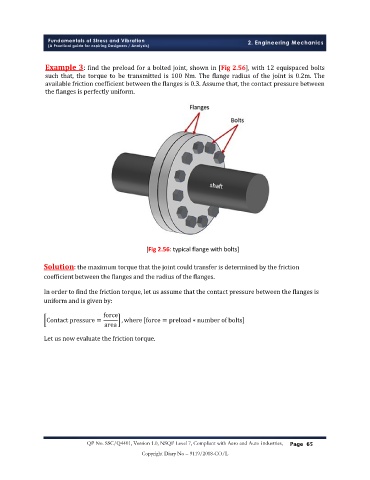
                 šƒ’Ž‡ ͵ǣ ϐ‹† –Ї ’”‡Ž‘ƒ† ˆ‘” ƒ „‘Ž–‡† Œ‘‹–ǡ •Š‘™ ‹ ȏ ‹‰ ʹǤͷ͸Ȑǡ ™‹–Š ͳʹ ‡“—‹•’ƒ…‡† „‘Ž–•
                •—…Š  –Šƒ–ǡ  –Ї  –‘”“—‡  –‘  „‡  –”ƒ•‹––‡†  ‹•  ͳͲͲ   Ǥ   Ї  ϐŽƒ‰‡  ”ƒ†‹—•  ‘ˆ  –Ї  Œ‘‹–  ‹•  ͲǤʹǤ   Ї
                ƒ˜ƒ‹Žƒ„އ ˆ”‹…–‹‘ …‘‡ˆϐ‹…‹‡– „‡–™‡‡ –Ї ϐŽƒ‰‡• ‹• ͲǤ͵Ǥ  ••—‡ –Šƒ–ǡ –Ї …‘–ƒ…– ’”‡••—”‡ „‡–™‡‡
                –Ї ϐŽƒ‰‡• ‹• ’‡”ˆ‡…–Ž› —‹ˆ‘”Ǥ


                                                 [Fig 2.56: typical flange with bolts]


                Solution: the maximum torque that the joint could transfer is determined by the friction
                coefficient between the flanges and the radius of the flanges.

                In order to find the friction torque, let us assume that the contact pressure between the flanges is
                uniform and is given by:

                                   force
                 Contact pressure =       , where  force = preload ∗ number of bolts
                                    area

                Let us now evaluate the friction torque.


                              QP No. SSC/Q4401, Version 1.0, NSQF Level 7, Compliant with Aero and Auto Industries,   P
                                                                                                 Page 65 age 65
                                                Copyright Diary No – 9119/2018-CO/L
   60   61   62   63   64   65   66   67   68   69   70