


Page 96 - Fisika Terapan for Engineers and Scientists
P. 96
296                                CHAPTER 9  Gravitation


                    your weight. Why don’t you feel these forces? (Hint: You and  the near and far surfaces of Io (due to Jupiter) with the
                    the Earth are in free fall toward the Sun and the Moon.)  difference in accelerations on the near and far side of
                  6. Calculate the gravitational force between our Galaxy and the  the Earth (due to the Moon), both as absolute accelera-
                                                     11
                    Andromeda galaxy.Their masses are 2.0   10 and 3.0   10 11  tions and as a fraction of the surface g. Io has a mass of  3
                                                                                22
                    times the mass of the Sun, respectively, and their separation is  8.9   10  kg and a radius of 1820 km, and is 422   10
                           6
                    2.2   10 light-years. Treat both galaxies as point masses.  km from the center of Jupiter.
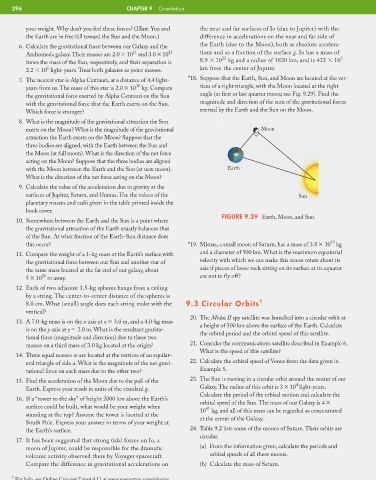
                  7. The nearest star is Alpha Centauri, at a distance of 4.4 light-  *18. Suppose that the Earth, Sun, and Moon are located at the ver-
                                                      30
                    years from us. The mass of this star is 2.0   10 kg. Compare  tices of a right triangle, with the Moon located at the right
                    the gravitational force exerted by Alpha Centauri on the Sun  angle (at first or last quarter moon; see Fig. 9.29). Find the
                    with the gravitational force that the Earth exerts on the Sun.  magnitude and direction of the sum of the gravitational forces
                    Which force is stronger?                             exerted by the Earth and the Sun on the Moon.
                  8. What is the magnitude of the gravitational attraction the Sun
                    exerts on the Moon? What is the magnitude of the gravitational          Moon
                    attraction the Earth exerts on the Moon? Suppose that the
                    three bodies are aligned, with the Earth between the Sun and
                    the Moon (at full moon). What is the direction of the net force
                    acting on the Moon? Suppose that the three bodies are aligned
                    with the Moon between the Earth and the Sun (at new moon).   Earth
                    What is the direction of the net force acting on the Moon?
                  9. Calculate the value of the acceleration due to gravity at the
                    surfaces of Jupiter, Saturn, and Uranus. Use the values of the                     Sun
                    planetary masses and radii given in the table printed inside the
                    book cover.
                                                                                FIGURE 9.29 Earth, Moon, and Sun.
                 10. Somewhere between the Earth and the Sun is a point where
                    the gravitational attraction of the Earth exactly balances that
                    of the Sun. At what fraction of the Earth–Sun distance does
                                                                                                                 19
                    this occur?                                      *19. Mimas, a small moon of Saturn, has a mass of 3.8   10 kg
                 11. Compare the weight of a 1-kg mass at the Earth’s surface with  and a diameter of 500 km. What is the maximum equatorial
                    the gravitational force between our Sun and another star of  velocity with which we can make this moon rotate about its
                    the same mass located at the far end of our galaxy, about   axis if pieces of loose rock sitting on its surface at its equator
                         20
                    5   10 m away.                                       are not to fly off?
                 12. Each of two adjacent 1.5-kg spheres hangs from a ceiling
                    by a string. The center-to-center distance of the spheres is
                    8.0 cm. What (small) angle does each string make with the  9.3 Circular Orbits  †
                    vertical?
                                                                      20. The Midas II spy satellite was launched into a circular orbit at
                 13. A 7.0-kg mass is on the x axis at x   3.0 m, and a 4.0-kg mass
                                                                         a height of 500 km above the surface of the Earth. Calculate
                    is on the y axis at y   2.0 m. What is the resultant gravita-
                                                                         the orbital period and the orbital speed of this satellite.
                    tional force (magnitude and direction) due to these two
                    masses on a third mass of 3.0 kg located at the origin?  21. Consider the communications satellite described in Example 6.
                                                                         What is the speed of this satellite?
                 14. Three equal masses m are located at the vertices of an equilat-
                    eral triangle of side a. What is the magnitude of the net gravi-  22. Calculate the orbital speed of Venus from the data given in
                    tational force on each mass due to the other two?    Example 5.
                 15. Find the acceleration of the Moon due to the pull of the  23. The Sun is moving in a circular orbit around the center of our
                                                                                                      4
                    Earth. Express your result in units of the standard g.  Galaxy. The radius of this orbit is 3   10 light-years.
                                                                         Calculate the period of the orbital motion and calculate the
                 16. If a “tower to the sky” of height 2000 km above the Earth’s
                                                                         orbital speed of the Sun. The mass of our Galaxy is 4
                    surface could be built, what would be your weight when  41
                                                                         10 kg, and all of this mass can be regarded as concentrated
                    standing at the top? Assume the tower is located at the
                                                                         at the center of the Galaxy.
                    South Pole. Express your answer in terms of your weight at
                    the Earth’s surface.                              24. Table 9.2 lists some of the moons of Saturn. Their orbits are
                                                                         circular.
                 17. It has been suggested that strong tidal forces on Io, a
                    moon of Jupiter, could be responsible for the dramatic  (a) From the information given, calculate the periods and
                    volcanic activity observed there by Voyager spacecraft.  orbital speeds of all these moons.
                    Compare the difference in gravitational accelerations on  (b) Calculate the mass of Saturn.

                †  For help see Online Concept Tutorial 11 at www wwnorton com/physics

