


Page 125 - Fisika Terapan for Engineers and Scientists
P. 125
10.3  The Motion of the Center of Mass                     325


                        If the net external force vanishes, then the acceleration of the center of mass
                     vanishes; hence the center of mass remains at rest or it moves with uniform velocity.


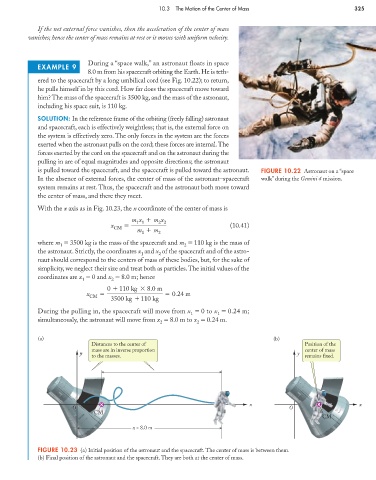
                                       During a “space walk,” an astronaut floats in space
                        EXAMPLE 9
                                       8.0 m from his spacecraft orbiting the Earth. He is teth-
                        ered to the spacecraft by a long umbilical cord (see Fig. 10.22); to return,
                        he pulls himself in by this cord. How far does the spacecraft move toward
                        him? The mass of the spacecraft is 3500 kg, and the mass of the astronaut,
                        including his space suit, is 110 kg.
                        SOLUTION: In the reference frame of the orbiting (freely falling) astronaut
                        and spacecraft, each is effectively weightless; that is, the external force on
                        the system is effectively zero. The only forces in the system are the forces
                        exerted when the astronaut pulls on the cord; these forces are internal.The
                        forces exerted by the cord on the spacecraft and on the astronaut during the
                        pulling in are of equal magnitudes and opposite directions; the astronaut
                        is pulled toward the spacecraft, and the spacecraft is pulled toward the astronaut.  FIGURE 10.22 Astronaut on a “space
                        In the absence of external forces, the center of mass of the astronaut–spacecraft  walk” during the Gemini 4 mission.
                        system remains at rest. Thus, the spacecraft and the astronaut both move toward
                        the center of mass, and there they meet.
                        With the x axis as in Fig. 10.23, the x coordinate of the center of mass is

                                                    m x   m x
                                                      1 1
                                                            2 2
                                              x                                   (10.41)
                                               CM
                                                      m   m
                                                       1    2
                        where m   3500 kg is the mass of the spacecraft and m   110 kg is the mass of
                               1                                    2
                        the astronaut. Strictly, the coordinates x and x of the spacecraft and of the astro-
                                                       1    2
                        naut should correspond to the centers of mass of these bodies, but, for the sake of
                        simplicity, we neglect their size and treat both as particles.The initial values of the
                        coordinates are x   0 and x   8.0 m; hence
                                     1        2
                                             0   110 kg    8.0 m
                                       x                        0.24 m
                                        CM
                                              3500 kg   110 kg
                        During the pulling in, the spacecraft will move from x   0 to x   0.24 m;
                                                                      1       1
                        simultaneously, the astronaut will move from x   8.0 m to x   0.24 m.
                                                             2          2
                        (a)                                                                    (b)
                                        Distances to the center of                                       Position of the
                                        mass are in inverse proportion                                   center of mass
                                     y                                                                 y
                                        to the masses.                                                   remains fixed.


                                                                                        x                                x
                                  O                                                                 O
                                         CM
                                                                                                              CM
                                                     x = 8.0 m


                        FIGURE 10.23 (a) Initial position of the astronaut and the spacecraft. The center of mass is between them.
                        (b) Final position of the astronaut and the spacecraft. They are both at the center of mass.

