


Page 121 - Fisika Terapan for Engineers and Scientists
P. 121
10.2  Center of Mass                           321


                        The position of the center of mass enters into the calculation of the gravitational
                     potential energy of an extended body located near the surface of the Earth. According
                     to Eq. (7.29), the potential energy of a single particle of mass m at a height y above
                     the ground is mgy. For a system of particles, the total gravitational potential energy is
                     then
                                        U   m gy   m gy    ...    m gy
                                             1  1    2  2        n  n
                                            (m y   m y    ...    m y ) g          (10.32)
                                              1 1   2 2         n n
                     Comparison with Eq. (10.19) shows that the quantity in parentheses is My  . Hence,
                                                                               CM
                     Eq. (10.32) becomes
                                                                                              potential energy in terms of height
                                                 U   Mgy                          (10.33)
                                                         CM                                   of center of mass

                     This expression for the gravitational potential energy of a system near the Earth’s sur-
                     face has the same mathematical form as for a single particle—it is as though the entire
                     mass of the system were located at the center of mass.
                        For a human body standing upright, the position of the center of mass is in the
                                                                                           Concepts
                     middle of the trunk, at about the height of the navel.This is therefore the height to be  in
                                                                                            Context
                     used in the calculation of the gravitational potential energy of the body. However, if the
                     body adopts any bent position, the center of mass shifts.


                      (a)                                    (b)
                      0.935L (0.069M)
                                                                 0.912L                     FIGURE 10.17 (a) Centers of mass of the
                                                                 0.812L
                                               0.717L (0.066M)                              body segments of an average male of mass
                      0.711L (0.461M)                                              0.672L
                                                0.553L (0.042M)                             M and height L standing upright. The num-
                                                0.431L (0.017M)  0.521L            0.462L   bers give the heights of the centers of mass
                                                                                            of the body segments from the floor and (in
                      0.425L (0.215M)
                                                                                            parentheses) the masses of the body seg-
                                                                 0.285L
                                                                                            ments; right and left limbs are shown com-
                      0.182L (0.096M)
                                                                                            bined. (b) Hinge points of the body. The
                      0.018L (0.034M)                            0.040L                     numbers give the heights of the joints from
                                                                                            the floor.
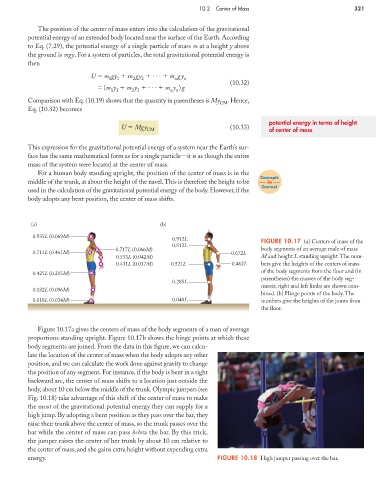
                        Figure 10.17a gives the centers of mass of the body segments of a man of average
                     proportions standing upright. Figure 10.17b shows the hinge points at which these
                     body segments are joined. From the data in this figure, we can calcu-
                     late the location of the center of mass when the body adopts any other
                     position, and we can calculate the work done against gravity to change
                     the position of any segment. For instance, if the body is bent in a tight
                     backward arc, the center of mass shifts to a location just outside the
                     body, about 10 cm below the middle of the trunk. Olympic jumpers (see
                     Fig. 10.18) take advantage of this shift of the center of mass to make
                     the most of the gravitational potential energy they can supply for a
                     high jump. By adopting a bent position as they pass over the bar, they
                     raise their trunk above the center of mass, so the trunk passes over the
                     bar while the center of mass can pass below the bar. By this trick,
                     the jumper raises the center of her trunk by about 10 cm relative to
                     the center of mass, and she gains extra height without expending extra
                     energy.                                                  FIGURE 10.18 High jumper passing over the bar.

