


Page 122 - Fisika Terapan for Engineers and Scientists
P. 122
322                                CHAPTER 10  Systems of Particles


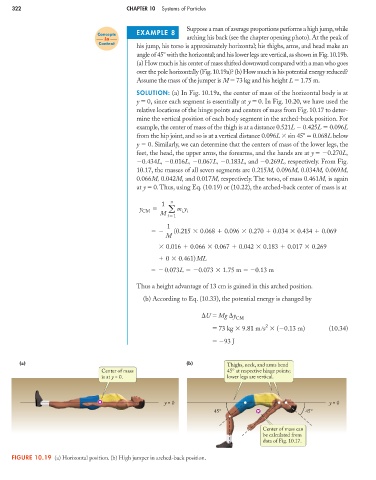
                                                                     Suppose a man of average proportions performs a high jump,while
                                          Concepts    EXAMPLE 8
                                            in                       arching his back (see the chapter opening photo). At the peak of
                                          Context
                                                      his jump, his torso is approximately horizontal; his thighs, arms, and head make an
                                                      angle of 45  with the horizontal;and his lower legs are vertical,as shown in Fig.10.19b.
                                                      (a) How much is his center of mass shifted downward compared with a man who goes
                                                      over the pole horizontally (Fig.10.19a)? (b) How much is his potential energy reduced?
                                                      Assume the mass of the jumper is M 73 kg and his height L 1.75 m.
                                                      SOLUTION: (a) In Fig. 10.19a, the center of mass of the horizontal body is at
                                                      y   0, since each segment is essentially at y   0. In Fig. 10.20, we have used the
                                                      relative locations of the hinge points and centers of mass from Fig. 10.17 to deter-
                                                      mine the vertical position of each body segment in the arched-back position. For
                                                      example, the center of mass of the thigh is at a distance 0.521L   0.425L   0.096L
                                                      from the hip joint, and so is at a vertical distance 0.096L   sin 45   0.068L below
                                                      y   0. Similarly, we can determine that the centers of mass of the lower legs, the
                                                      feet, the head, the upper arms, the forearms, and the hands are at y   0.270L,
                                                       0.434L,  0.016L,  0.067L,  0.183L, and  0.269L, respectively. From Fig.
                                                      10.17, the masses of all seven segments are 0.215M, 0.096M, 0.034M, 0.069M,
                                                      0.066M, 0.042M, and 0.017M, respectively. The torso, of mass 0.461M, is again
                                                      at y   0. Thus, using Eq. (10.19) or (10.22), the arched-back center of mass is at


                                                             1  n
                                                       y       a  m y
                                                        CM         i i
                                                             M
                                                               i 1
                                                               1
                                                                  (0.215   0.068   0.096   0.270   0.034   0.434   0.069
                                                               M
                                                              0.016   0.066   0.067   0.042   0.183   0.017   0.269
                                                              0   0.461)ML
                                                            0.073L   0.073   1.75 m   0.13 m

                                                      Thus a height advantage of 13 cm is gained in this arched position.

                                                        (b) According to Eq. (10.33), the potential energy is changed by

                                                                          U  Mg  y
                                                                                    CM
                                                                                             2
                                                                               73 kg   9.81 m	s   ( 0.13 m)     (10.34)
                                                                               93 J


                  (a)                                                (b)         Thighs, neck, and arms bend
                                           Center of mass                        45° at respective hinge points;
                                           is at y = 0.                          lower legs are vertical.


                                                              y = 0                                             y = 0
                                                                             45°                         45°

                                                                                            Center of mass can
                                                                                            be calculated from
                                                                                            data of Fig. 10.17.


                FIGURE 10.19 (a) Horizontal position. (b) High jumper in arched-back position.

