


Page 126 - Fisika Terapan for Engineers and Scientists
P. 126
326                                CHAPTER 10  Systems of Particles


                                                      COMMENT: The distances moved by the astronaut and by the spacecraft are in
                                                      the inverse ratio of their masses.The astronaut (of small mass) moves a large dis-
                                                      tance, and the spacecraft (of large mass) moves a smaller distance.This is the result
                                                      of the accelerations that the pull of the cord gives to these bodies: with forces of equal
                                                      magnitudes, the accelerations of the astronaut and spacecraft are in the inverse
                                                      ratio of their masses. However, our method of calculation based on the fixed posi-
                                                      tion of the center of mass gives us the final positions directly, without any need to
                                                      examine accelerations.


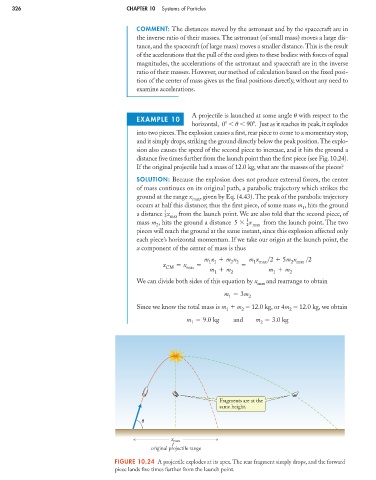
                                                                       A projectile is launched at some angle   with respect to the
                                                      EXAMPLE 10
                                                                       horizontal, 0        90 . Just as it reaches its peak,it explodes
                                                      into two pieces.The explosion causes a first,rear piece to come to a momentary stop,
                                                      and it simply drops, striking the ground directly below the peak position.The explo-
                                                      sion also causes the speed of the second piece to increase, and it hits the ground a
                                                      distance five times further from the launch point than the first piece (see Fig. 10.24).
                                                      If the original projectile had a mass of 12.0 kg, what are the masses of the pieces?

                                                      SOLUTION: Because the explosion does not produce external forces, the center
                                                      of mass continues on its original path, a parabolic trajectory which strikes the
                                                      ground at the range x max , given by Eq. (4.43).The peak of the parabolic trajectory
                                                      occurs at half this distance; thus the first piece, of some mass m , hits the ground
                                                                                                        1
                                                              1
                                                      a distance  x max  from the launch point. We are also told that the second piece, of
                                                              2
                                                                                       1
                                                            2
                                                      mass m , hits the ground a distance  5   x   from the launch point. The two
                                                                                       2 max
                                                      pieces will reach the ground at the same instant, since this explosion affected only
                                                      each piece’s horizontal momentum. If we take our origin at the launch point, the
                                                      x component of the center of mass is thus
                                                                          m x   m x     m x   >2   5m x   >2
                                                                                                     2  max
                                                                            1 1
                                                                                  2  2
                                                              x     x                    1 max
                                                               CM    max
                                                                            m   m             m   m
                                                                             1    2            1    2
                                                      We can divide both sides of this equation by x max  and rearrange to obtain
                                                                                m   3m
                                                                                  1     2
                                                      Since we know the total mass is m   m   12.0 kg, or 4m   12.0 kg, we obtain
                                                                                 1
                                                                                                    2
                                                                                      2
                                                                     m   9.0 kg          and         m   3.0 kg
                                                                      1                    2


                                                                               Fragments are at the
                                                                               same height.


                                                                x max
                                                          original projectile range
                                               FIGURE 10.24 A projectile explodes at its apex. The rear fragment simply drops, and the forward
                                               piece lands five times further from the launch point.

