


Page 123 - Fisika Terapan for Engineers and Scientists
P. 123
10.3  The Motion of the Center of Mass                     323


                                             These distances follow
                                             directly from the centers  FIGURE 10.20 The vertical positions of the centers of
                                             of mass and hinge points  mass of the body segments. These are determined from
                                             in Fig. 10.17.
                                                                       the locations of the hinge joints and centers of mass in
                                                                       Fig. 10.17 and the geometry of the arched-back position.


                                         45 5° °      45° °       0.016L                y = 0
                                                      45
                                   0.068L                               0.067L
                                                                             0.183L
                             0.270L                                                0.269L
                        0.434L


                                                                                              (a)


                      ✔      Checkup 10.2


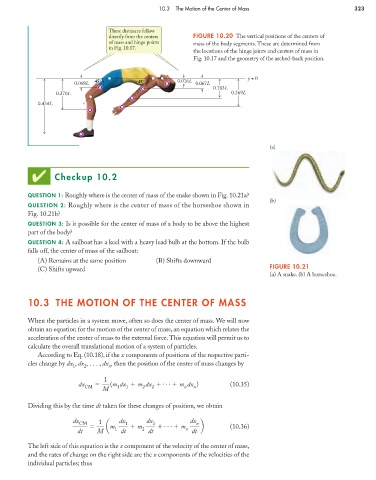
                     QUESTION 1: Roughly where is the center of mass of the snake shown in Fig. 10.21a?
                                                                                              (b)
                     QUESTION 2: Roughly where is the center of mass of the horseshoe shown in
                     Fig. 10.21b?
                     QUESTION 3: Is it possible for the center of mass of a body to be above the highest
                     part of the body?
                     QUESTION 4: A sailboat has a keel with a heavy lead bulb at the bottom. If the bulb
                     falls off, the center of mass of the sailboat:
                        (A) Remains at the same position    (B) Shifts downward
                        (C) Shifts upward                                                     FIGURE 10.21
                                                                                              (a) A snake. (b) A horseshoe.


                     10.3 THE MOTION OF THE CENTER OF MASS


                     When the particles in a system move, often so does the center of mass. We will now
                     obtain an equation for the motion of the center of mass, an equation which relates the
                     acceleration of the center of mass to the external force.This equation will permit us to
                     calculate the overall translational motion of a system of particles.
                        According to Eq. (10.18), if the x components of positions of the respective parti-
                     cles change by dx , dx ,..., dx , then the position of the center of mass changes by
                                  1
                                      2
                                             n
                                            1
                                    dx        (m dx   m dx         m dx )         (10.35)
                                      CM        1  1    2  2         n  n
                                           M
                     Dividing this by the time dt taken for these changes of position, we obtain

                                  dx CM   1     dx 1     dx 2         dx n
                                              am      m               m      b    (10.36)
                                    dt    M    1  dt   2  dt         n  dt
                     The left side of this equation is the x component of the velocity of the center of mass,
                     and the rates of change on the right side are the x components of the velocities of the
                     individual particles; thus

