


Page 143 - Fisika Terapan for Engineers and Scientists
P. 143
11.1  Impulsive Forces                          343


                       PHYSICS IN PRACTICE              AUTOMOBILE COLLISIONS


                                 We can fully appreciate the effects of the second-  However, the impact can still be fatal—you wouldn’t expect to
                        Concepts
                          in     ary impact on the human body if we compare the  survive a jump from an 11-floor building onto an air mattress.
                        Context
                                 impact speeds of a human body on the dashboard  For maximum protection,a seat belt should always be worn
                                 or the windshield with the speed attained by a  even in vehicles equipped with air bags. In lateral collisions, in
                       body in free fall from some height.The impact of the head on  repeated collisions (such as in car pileups), and in rollovers, an
                       the windshield at 15 m s is equivalent to falling four floors  air bag is of little help, and a seat belt is essential. The effec-
                       down from an apartment building and landing headfirst on a  tiveness of seat belts is well demonstrated by the experiences of
                       hard surface.Our intuition tells us that this is likely to be fatal.  race car drivers. Race car drivers wear lap belts and crossed
                       Since our intuition about the dangers of heights is much better  shoulder belts. Even in spectacular crashes at very high speeds
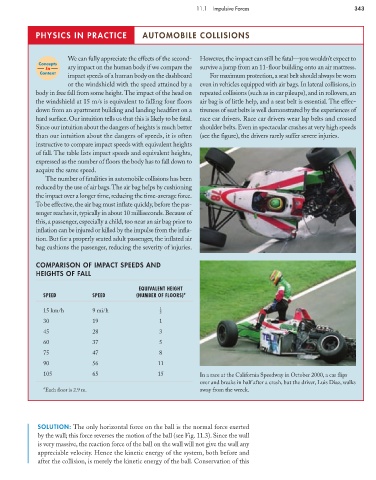
                       than our intuition about the dangers of speeds, it is often  (see the figure), the drivers rarely suffer severe injuries.
                       instructive to compare impact speeds with equivalent heights
                       of fall. The table lists impact speeds and equivalent heights,
                       expressed as the number of floors the body has to fall down to
                       acquire the same speed.
                          The number of fatalities in automobile collisions has been
                       reduced by the use of air bags.The air bag helps by cushioning
                       the impact over a longer time,reducing the time-average force.
                       To be effective,the air bag must inflate quickly,before the pas-
                       senger reaches it,typically in about 10 milliseconds.Because of
                       this, a passenger, especially a child, too near an air bag prior to
                       inflation can be injured or killed by the impulse from the infla-
                       tion. But for a properly seated adult passenger, the inflated air
                       bag cushions the passenger, reducing the severity of injuries.

                       COMPARISON OF IMPACT SPEEDS AND
                       HEIGHTS OF FALL

                                                      EQUIVALENT HEIGHT
                         SPEED          SPEED         (NUMBER OF FLOORS) a

                         15 km h        9  mi h              1 3
                         30             19                   1
                         45             28                   3
                         60             37                   5
                         75             47                   8
                         90             56                  11
                         105            65                  15           In a race at the California Speedway in October 2000, a car flips
                                                                         over and breaks in half after a crash, but the driver, Luis Diaz, walks
                         a
                          Each floor is 2.9 m.                           away from the wreck.


                        SOLUTION: The only horizontal force on the ball is the normal force exerted
                        by the wall; this force reverses the motion of the ball (see Fig. 11.3). Since the wall
                        is very massive, the reaction force of the ball on the wall will not give the wall any
                        appreciable velocity. Hence the kinetic energy of the system, both before and
                        after the collision, is merely the kinetic energy of the ball. Conservation of this

