


Page 144 - Fisika Terapan for Engineers and Scientists
P. 144
344                                CHAPTER 11  Collisions


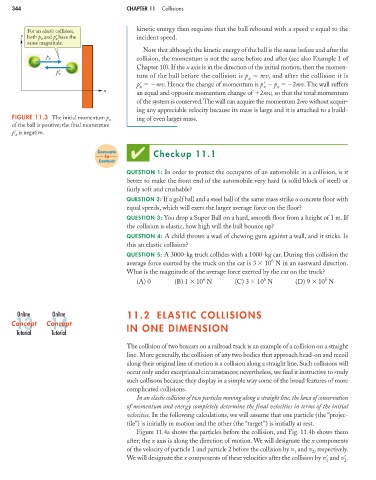
                                                      kinetic energy then requires that the ball rebound with a speed v equal to the
                     For an elastic collision,
                   y  both p  and p' have the         incident speed.
                         x
                             x
                     same magnitude.
                                                        Note that although the kinetic energy of the ball is the same before and after the
                                                      collision, the momentum is not the same before and after (see also Example 1 of
                          p x
                                                      Chapter 10). If the x axis is in the direction of the initial motion, then the momen-
                             p' x
                                                      tum of the ball before the collision is p   mv, and after the collision it is
                                                                                        x
                                                      p    mv. Hence the change of momentum is p    p   2mv.The wall suffers
                                                       x                                    x   x
                                            x
                                                      an equal and opposite momentum change of 	2mv, so that the total momentum
                                                      of the system is conserved.The wall can acquire the momentum 2mv without acquir-
                                                      ing any appreciable velocity because its mass is large and it is attached to a build-
                FIGURE 11.3 The initial momentum p    ing of even larger mass.
                                             x
                of the ball is positive; the final momentum
                p' is negative.
                 x
                                          Concepts  ✔      Checkup 11.1
                                            in
                                          Context
                                                   QUESTION 1: In order to protect the occupants of an automobile in a collision, is it
                                                   better to make the front end of the automobile very hard (a solid block of steel) or
                                                   fairly soft and crushable?
                                                   QUESTION 2: If a golf ball and a steel ball of the same mass strike a concrete floor with
                                                   equal speeds, which will exert the larger average force on the floor?
                                                   QUESTION 3: You drop a Super Ball on a hard, smooth floor from a height of 1 m. If
                                                   the collision is elastic, how high will the ball bounce up?
                                                   QUESTION 4: A child throws a wad of chewing gum against a wall, and it sticks. Is
                                                   this an elastic collision?
                                                   QUESTION 5: A 3000-kg truck collides with a 1000-kg car. During this collision the
                                                                                               6
                                                   average force exerted by the truck on the car is 3   10 N in an eastward direction.
                                                   What is the magnitude of the average force exerted by the car on the truck?
                                                                          6
                                                                                            6
                                                                                                               6
                                                      (A) 0      (B) 1   10 N       (C)   10 N        (D) 9   10 N
                                                                                       3
                  Online    Online                 11.2 ELASTIC COLLISIONS
                 13         14
                Concept   Concept                  IN ONE DIMENSION
                 Tutorial   Tutorial
                                                   The collision of two boxcars on a railroad track is an example of a collision on a straight
                                                   line. More generally, the collision of any two bodies that approach head-on and recoil
                                                   along their original line of motion is a collision along a straight line. Such collisions will
                                                   occur only under exceptional circumstances; nevertheless, we find it instructive to study
                                                   such collisons because they display in a simple way some of the broad features of more
                                                   complicated collisions.
                                                      In an elastic collision of two particles moving along a straight line,the laws of conservation
                                                   of momentum and energy completely determine the final velocities in terms of the initial
                                                   velocities. In the following calculations, we will assume that one particle (the “projec-
                                                   tile”) is initially in motion and the other (the “target”) is initially at rest.
                                                      Figure 11.4a shows the particles before the collision, and Fig. 11.4b shows them
                                                   after; the x axis is along the direction of motion. We will designate the x components
                                                   of the velocity of particle 1 and particle 2 before the collision by v and v , respectively.
                                                                                                      1    2
                                                   We will designate the x components of these velocities after the collision by v  and v .
                                                                                                               1     2

