Page 145 - Fisika Terapan for Engineers and Scientists
P. 145
11.2  Elastic Collisions in One Dimension                    345


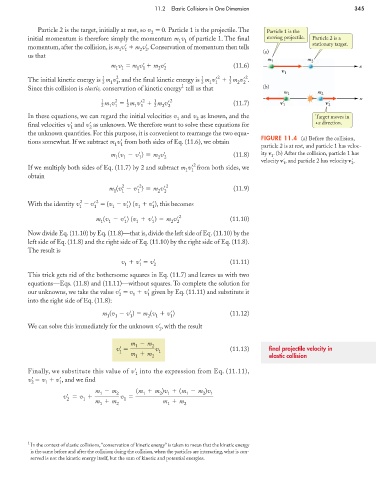
                        Particle 2 is the target, initially at rest, so v   0. Particle 1 is the projectile. The
                                                          2                                  Particle 1 is the
                     initial momentum is therefore simply the momentum m v of particle 1. The final  moving projectile.  Particle 2 is a
                                                                   1 1
                     momentum, after the collision, is m v  	 m v . Conservation of momentum then tells    stationary target.
                                                1 1    2 2                                  (a)
                     us that
                                                                                              m 1         m 2
                                              m v   m v  	 m v                     (11.6)                                x
                                               1 1    1 1   2 2
                                                                                                  v 1
                                                                         1
                                           1
                                                                              2
                                                                                  1
                                                2
                     The initial kinetic energy is  m v , and the final kinetic energy is  m v  	 m v  2 .
                                                                            1 1
                                                                                  2
                                                                         2
                                                                                    2 2
                                           2
                                              1 1
                                                                   1
                     Since this collision is elastic, conservation of kinetic energy tell us that  (b)
                                                                                                  m 1        m 2
                                                                                                                          x
                                                        2
                                               2
                                                           1
                                                   1
                                           1  m v    m v  	  m v  2                              v'            v'
                                           2  1 1  2  1 1  2  2 2                  (11.7)         1             2
                     In these equations, we can regard the initial velocities v and v as known, and the     Target moves in
                                                                  1     2
                     final velocities v  and v  as unknown. We therefore want to solve these equations for  +x direction.
                                  1
                                       2
                     the unknown quantities. For this purpose, it is convenient to rearrange the two equa-
                                                                                            FIGURE 11.4 (a) Before the collision,
                     tions somewhat. If we subtract m v  from both sides of Eq. (11.6), we obtain  particle 2 is at rest, and particle 1 has veloc-
                                               1 1
                                              m (v   v )   m v                     (11.8)   ity v . (b) After the collision, particle 1 has
                                                                                               1
                                               1  1    1    2 2
                                                                                            velocity v' , and particle 2 has velocity v' .
                                                                                                  1
                                                                                                                       2
                                                                       2
                     If we multiply both sides of Eq. (11.7) by 2 and subtract m v  from both sides, we
                                                                     1 1
                     obtain
                                                 2
                                                       2
                                             m (v   v  )   m v  2                  (11.9)
                                               1  1   1     2 2
                                     2    2
                     With the identity v   v    (v   v ) (v 	 v ), this becomes
                                    1    1    1    1  1    1
                                         m (v   v ) (v 	 v )   m v  2             (11.10)
                                                      1
                                                                2 2
                                                  1
                                                          1
                                             1
                                           1
                     Now divide Eq. (11.10) by Eq. (11.8)—that is, divide the left side of Eq. (11.10) by the
                     left side of Eq. (11.8) and the right side of Eq. (11.10) by the right side of Eq. (11.8).
                     The result is
                                                 v 	 v    v  2                    (11.11)
                                                       1
                                                  1
                     This trick gets rid of the bothersome squares in Eq. (11.7) and leaves us with two
                     equations—Eqs. (11.8) and (11.11)—without squares. To complete the solution for
                     our unknowns, we take the value v    v 	 v  given by Eq. (11.11) and substitute it
                                                2    1   1
                     into the right side of Eq. (11.8):
                                           m (v   v )   m (v 	 v )                (11.12)
                                                    1
                                                            1
                                               1
                                                                1
                                             1
                                                         2
                     We can solve this immediately for the unknown v , with the result
                                                             1
                                                    m   m 2
                                                     1
                                                v           v                     (11.13)     final projectile velocity in
                                                 1           1
                                                    m 	 m 2                                   elastic collision
                                                     1
                     Finally, we substitute this value of v  into the expression from Eq. (11.11),
                                                     1
                     v    v 	 v , and we find
                      2   1   1
                                         m   m  2     (m 	 m )v 	 (m   m )v 1
                                                                          2
                                           1
                                                                     1
                                                        1
                                                               1
                                                             2
                                v    v 	         v
                                                  1
                                 2
                                      1
                                         m 	 m  2             m 	 m 2
                                                               1
                                           1
                     1
                      In the context of elastic collisions,“conservation of kinetic energy” is taken to mean that the kinetic energy
                      is the same before and after the collision; duing the collision, when the particles are interacting, what is con-
                      served is not the kinetic energy itself, but the sum of kinetic and potential energies.
   140   141   142   143   144   145   146   147   148   149   150