


Page 147 - Fisika Terapan for Engineers and Scientists
P. 147
11.2  Elastic Collisions in One Dimension                    347


                     and Eq. (11.14) becomes
                                                                                                 Exposures are at
                                                                                                 equal time intervals.
                                                    2m 1
                                               v         v   0                    (11.16)
                                                2   m    1
                                                      2
                     This means the projectile bounces off the target with a reversed velocity and the target
                     remains nearly stationary (as in the case of the Super Ball bouncing off the wall; see
                     Example 3).
                        Conversely, if the mass of the projectile is much larger than the mass of the target,
                     then m can be neglected compared with m , and Eqs. (11.13) and (11.14) become
                          2                            1
                                                    m                                                   When struck by a larger
                                                v     1   v   v                   (11.17)               mass, the smaller mass
                                                 1  m   1   1
                                                      1                                                 moves off at higher speed.
                     and
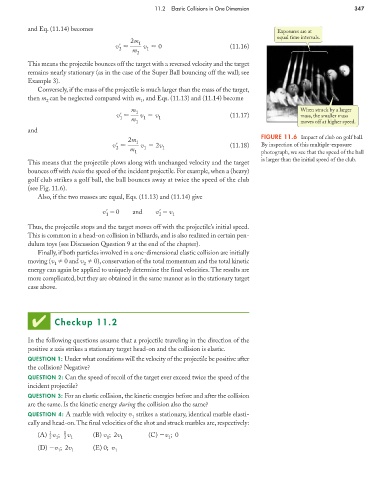
                                                                                            FIGURE 11.6 Impact of club on golf ball.
                                                   2m 1
                                              v         v   2v                    (11.18)   By inspection of this multiple-exposure
                                                2   m   1     1
                                                     1                                      photograph, we see that the speed of the ball
                                                                                            is larger than the initial speed of the club.
                     This means that the projectile plows along with unchanged velocity and the target
                     bounces off with twice the speed of the incident projectile. For example, when a (heavy)
                     golf club strikes a golf ball, the ball bounces away at twice the speed of the club
                     (see Fig. 11.6).
                        Also, if the two masses are equal, Eqs. (11.13) and (11.14) give

                                           v    0    and    v    v 1
                                             1
                                                             2
                     Thus, the projectile stops and the target moves off with the projectile’s initial speed.
                     This is common in a head-on collision in billiards, and is also realized in certain pen-
                     dulum toys (see Discussion Question 9 at the end of the chapter).
                        Finally, if both particles involved in a one-dimensional elastic collision are initially
                     moving (v
 0 and v
 0), conservation of the total momentum and the total kinetic
                             1        2
                     energy can again be applied to uniquely determine the final velocities.The results are
                     more complicated, but they are obtained in the same manner as in the stationary target
                     case above.


                      ✔      Checkup 11.2


                     In the following questions assume that a projectile traveling in the direction of the
                     positive x axis strikes a stationary target head-on and the collision is elastic.
                     QUESTION 1: Under what conditions will the velocity of the projectile be positive after
                     the collision? Negative?
                     QUESTION 2: Can the speed of recoil of the target ever exceed twice the speed of the
                     incident projectile?
                     QUESTION 3: For an elastic collision, the kinetic energies before and after the collision
                     are the same. Is the kinetic energy during the collision also the same?
                     QUESTION 4: A marble with velocity v strikes a stationary, identical marble elasti-
                                                    1
                     cally and head-on.The final velocities of the shot and struck marbles are, respectively:
                           1
                        (A)   v ;  1 2 v 1  (B) v ;2v 1  (C)  v ;0
                             1
                           2
                                             1
                                                               1
                        (D)  v ;2v       (E) 0; v
                              1   1            1

